LiDAR Sensor Selection for Field Robotics Applications
How to match five critical LiDAR specs to the harsh realities of outdoor robot work.

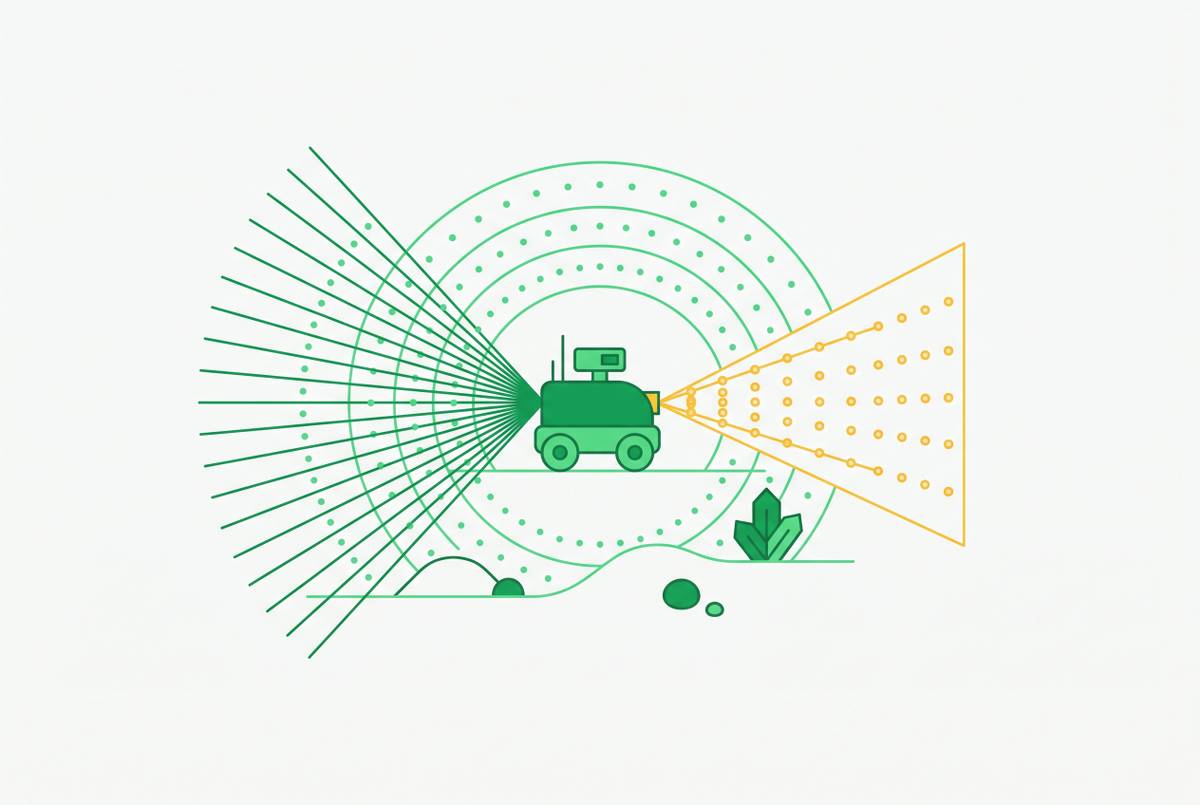
Range, field of view, point density, ingress protection, and tolerance for heat, cold, and vibration all have to line up against an environment that changes by the hour. Get one of those wrong and the failure spreads: a bad range choice bleeds into a navigation failure, and a bad IP rating ends a robot's service life early. Most buying conversations still work through them one at a time. That's backwards, and it's the mistake this piece is built to correct.
The different burden field robotics imposes on LiDAR compared to structured environments
Indoor autonomous mobile robots have it easy. Lighting stays constant, floors stay flat, obstacle types stay within a known set, and the range a sensor needs to cover barely shifts from one day to the next.
Field robots get none of that. A sensor tuned for warehouse SLAM can fail outright the moment it leaves the warehouse, and it won't fail gently.
That's what makes the selection decision so consequential. A bad choice in range, field of view, IP rating, wavelength, or mechanical architecture raises costs elsewhere in the system, showing up as a missed obstacle, a safety incident, or a robot down for repair more often than it's out working.
How the two underlying sensing technologies affect outdoor use
Time-of-Flight, or ToF, is the established approach. Fire a short laser pulse, measure how long it takes to bounce back, calculate distance from the round trip. It's the dominant technology across production vehicles and the field robotics platforms doing real work right now, and its maturity shows in the tooling and support built up around it over years of deployment.
FMCW works differently. Instead of pulses, it sends a continuous low-power beam and reads the frequency shift in what comes back, picking up velocity in the same measurement as depth and reflectivity. On paper it should win on range and sensitivity. In practice it runs into a problem baked into the technique itself, and this is where the FMCW pitch usually oversells.
The ultra-narrow optical bandwidth FMCW depends on generates real speckle noise, which degrades signal uniformity and cuts into detection statistics enough to erode much of the range and sensitivity advantage FMCW claims on paper. That's a real cost, not a marketing objection from a ToF competitor. Neither method wins outright, but for most field deployments running today, ToF's maturity and field-proven tooling outweigh FMCW's theoretical ceiling, and the tradeoff belongs inside the evaluation for a given robot's use case rather than settled by whichever camp's slide deck reads better.
Mechanical spinning vs. solid-state architecture and the durability tradeoff
A second question follows the sensing method: does the unit spin, or does it sit still? For most field deployments, sit still wins for mechanical reasons.
Rotating sensors deliver a full 360-degree horizontal sweep, point cloud quality proven out over years of use, and an ecosystem, RoboSense's RS-Helios-16P among them, deeply supported across ROS for research and prototyping. That maturity counts for something. But a spinning sensor has moving parts, and moving parts are what vibration, dust, and standing water go after first. A rotating LiDAR on a mower crossing rough turf for a season wears its bearing down, and that wear tells the real story about which architecture belongs on unstructured ground.
Solid-state sensors skip the moving parts. No rotor, no bearing, which tends to mean higher reliability, a smaller footprint, and lower power draw, exactly the profile that suits mass production and equipment that has to survive a season of dust and vibration rather than a single trade show demo. RoboSense's EMX is ASIL-B certified, has no spinning components, is rated IP6K9K so it survives pressure washing, delivers 192 beams, 300-meter range, and strong angular resolution. That's automotive-grade durability landing in a field robotics application.
The pattern holds across solid-state designs broadly. Reliability at scale comes from removing the component that wears out, and any field deployment planning past a single pilot season should weight that fact heavily.
Wavelength choice: how 905 nm and 1550 nm behave differently in outdoor conditions
Wavelength gets less attention than range or field of view in most buying conversations, and that's a mistake. It quietly decides how a sensor behaves once weather actually gets involved.
905 nm costs less to produce, attenuates less as the signal travels, and generally holds up better across changing weather and target surfaces, which makes it a domain-relevant choice for field robotics rather than just the cheap fallback. 1550 nm reaches farther at the same power level because it scatters less in the atmosphere and can legally run at higher power: that wavelength gets absorbed by the cornea and lens rather than reaching the retina, so eye-safety limits allow more power before the sensor becomes a hazard. That extra headroom is what buys the longer range.
None of it comes free. 1550 nm systems cost more, both because the components are harder to make and because production volumes stay smaller, so the choice comes down to how much range the mission actually needs, what the safety requirements demand, what conditions the sensor has to survive, and what the budget allows. The physics behind 1550 nm's higher allowable power and lower atmospheric scatter consistently points to a meaningful range advantage over 905 nm against low-reflectivity targets. For most field robots that gap barely matters, since operating ranges tend to stay under 200 meters, where 905 nm already does the job. Paying the 1550 nm premium (which achieves longer ranges at the same power level and allows higher power output while maintaining eye safety) for a robot like the RoboSense Fairy or RS-Helios-16P, both with a max range of 150 m, is money spent on a capability nobody needed, and that's the default mistake this section exists to head off.
The five parameters that define sensor fit for a field environment
Range comes first, and most field robots operate well within a 200-meter envelope, and manufacturing and industrial automation drive a large share of overall LiDAR demand. Most field robots never need to go past that envelope. Agricultural inspection rigs, perimeter security units, and ground vehicles working open terrain are the exceptions that push toward the upper end or beyond it. Datasheet range figures almost always get quoted against a high-reflectivity white target, so the number worth asking for is range at 10% NIST reflectivity, since that's what soil, crop canopy, and bare unpainted metal actually give back. RoboSense's Fairy lists a 150-meter max range but 80 meters at 10% reflectivity, and the RS-Helios-16P lists the same 150-meter max yet holds up better at 90 meters under the same low-reflectivity test. Anyone reading only the headline number on a spec sheet is buying blind, and it's the single most common mistake in this entire selection process.
Vertical coverage decides how much of the ground the sensor actually sees, and it's the parameter that gets underweighted most often. Livox's Mid-360 covers 59 degrees vertically against 70 degrees for competing units, an 11-degree gap that makes a real difference in reading the shape of the ground under the robot's wheels. Long-range forward-looking work generally calls for at least 100 by 20 degrees (H by V), resolution around 0.05 by 0.05 degrees in the zone that matters, and a frame rate of 10 Hz or better. Solid-state sensors with a narrower native field of view often need two or more units bolted together to cover the same ground, and that adds cost, calibration work, and integration headaches a single mechanical unit avoids.
Point density and angular resolution decide whether a system can tell a rock from a rut from a low patch of vegetation, and that distinction is what agricultural and off-road applications live or die on. Angular resolution is the finer-grained cousin of density, the precision behind each individual point, and here the EMX's tight angular resolution sits well ahead of entry-level sensors; tighter spacing between scan lines is what actually lets a system detect the ground plane accurately at distance. More density isn't automatically better, though. Every extra point is extra data the onboard compute has to chew through in real time, so the right move is matching density to the detection task at hand, not chasing the biggest number on the sheet.
Ingress protection closes the list, and IP69K (sometimes written IP6K9K) withstands pressure washing at up to 1,600 psi, which matters a great deal for agricultural gear that gets hosed down as routine maintenance. Ouster's OS line carries IP69K and lists an operating range from -40°C to 64°C across rain, snow, and fog, a documented envelope that maps directly onto field conditions. SICK's TiM781S, a 2D sensor rated IP67 with 270-degree coverage and up to a 25-meter range, fits cold-chain logistics and other semi-outdoor environments, proof that 2D sensors with strong IP ratings still have a role in simpler field deployments. The rating covers the sensor housing itself; the connectors, cable glands, and mounting hardware around it need their own evaluation, because a sealed sensor bolted on with an unsealed connector meets none of its rated protection at the system level.
The interacting parameters and the tradeoffs that can't be resolved independently
Pushing on one bends at least one other. That's the part a spec sheet never tells you.
Range and density fight each other by physics: spread the same laser power over a longer distance and the returns land more sparsely, so a 150-meter sensor's point cloud at 100 meters is meaningfully thinner than the same sensor's cloud at 30 meters. Wide field of view fights resolution the same way. Sensors built to sweep 360 degrees horizontally and wide arcs vertically tend to land at lower angular resolution than narrow forward-facing units, so a terrain-aware field robot trades a crisp ground-plane map for full awareness in every direction. No single unit gets both, and anyone shopping for one sensor to do everything is shopping for a sensor that doesn't exist.
Solid-state architecture runs into its own version of the same wall. Achieving a 360-degree horizontal sweep with solid-state sensors requires multiple units, which adds cost and calibration complexity and creates potential occlusion right where the units' coverage meets at the seams.
Even ingress protection carries a hidden cost. A housing rated for pressure washing needs an optical window tough enough to survive it, and that same window is exactly where dirt film, standing water, and scratches build up over time, degrading the signal passing through it. This concern folds straight back into the sensing-technology decision made earlier, reinforcing why ToF remains the safer default for wet field conditions. None of these tradeoffs resolves spec by spec. Those tradeoffs either get worked out together, or they stay unresolved and appear later as a field failure.
Specific sensors worth evaluating across field robotics use cases
For an outdoor mobile robot that needs full 360-degree coverage and range past the entry tier, RoboSense's Fairy earns a close look: 360 degrees horizontal, 32 degrees vertical, 150-meter max range dropping to 80 meters at 10% reflectivity, ranging accuracy of 0.5 cm (1σ), the best figure in its lineup, and roughly 1,370,000 points per second in 96-beam mode, a spec sheet aimed squarely at delivery robots and agricultural inspection platforms.
For mounting where space runs tight, a drone arm or behind a fascia panel, RoboSense's E1R fits the job: solid-state, 144 beams, 120 by 90 degree field of view, 75-meter max range dropping to 30 meters at 10% reflectivity, IP67 and IP6K9K rated, and just 7 mm thick.
RoboSense's M1 Plus is MEMS solid-state, with a 120 by 25 degree field of view, 200-meter range dropping to 180 at 10% reflectivity, IP67 and IP6K9K rated, with ASIL certification.
None of these wins on every axis, and none should. The right sensor comes out of the mission profile, weighing the range the terrain demands against the vertical coverage the ground requires, the density the detection task needs, and the environment the housing has to survive.