Beyond Visual Line of Sight Waivers for Agricultural Drones in the US
Farmers need BVLOS approval to make agricultural drones economically viable.
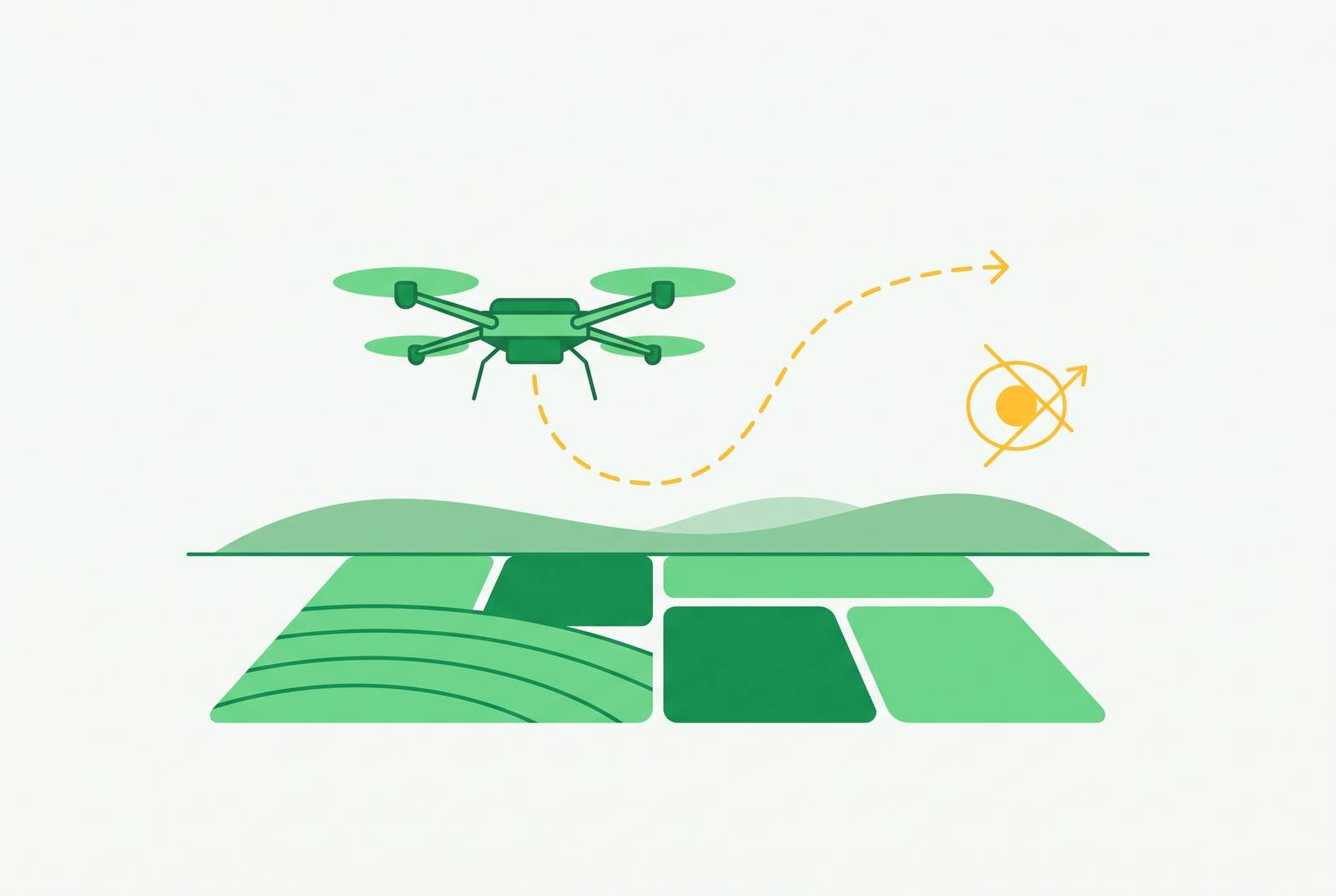
American farms are too big for drones to work under visual line of sight rules, so beyond visual line of sight (BVLOS) authority is a practical necessity, not a regulatory nicety. Visual line of sight (VLOS) rules require a pilot or a visual observer to keep the aircraft in unaided sight at all times. That works for a small plot. It breaks down across hundreds of contiguous acres, where no single person standing in a field can see far enough to track a drone through its full route.
Drone spraying pays off economically only if it can cover large areas without adding labor. Precision agriculture analysis found drone use could save American farmers $700 million a year, and that figure depends on treating fields at the scale drones are actually built for, not at the scale a visual observer can watch. Restrict a spray drone to what one person can see, and the savings the technology promises mostly disappear, because the cost of staffing enough observers to cover real acreage cancels out the labor the drone was supposed to replace.
The Department of Transportation's Inspector General made the stakes explicit in an audit, finding that advancing scalable BVLOS operations matters for keeping the United States ahead in aeronautics and for extending safety benefits across transportation generally. That framing puts BVLOS progress in the same conversation as national competitiveness, not just farm economics.
This mismatch appears first and hardest in agricultural spraying. Fields are routinely too big for any ground-based observer to monitor, so without routine BVLOS authority, operators end up stationing visual observers across acreage, where their presence adds cost but no real margin of safety. The rules built for small, contained operations end up governing an activity that was never going to fit inside them.
The weight problem that puts most spray drones outside Part 107 before BVLOS even enters the picture
Before BVLOS even enters the conversation, most serious agricultural spray drones run into a separate wall: weight. Part 107 governs small unmanned aircraft systems under 55 pounds, but a loaded spray drone carries the chemical payload that makes it useful in the first place, so it routinely exceeds that limit. Once it does, the aircraft falls outside Part 107 entirely, and the Part 107 waiver pathway that smaller drones use to get BVLOS approval simply isn't available to it.
Operators of these heavier aircraft have to get a statutory exemption instead, granted under 49 U.S.C. §44807 and commonly called a Section 44807 exemption. It runs on different legal footing than a Part 107 waiver and needs its own evidence. Stacked on top of it is a second certification: large agricultural drone operators also need an agricultural aircraft operator certificate under Part 137, a requirement with no equivalent in the small-drone world.
This two-layer burden, weight disqualification followed by a Part 137 add-on, has shaped where exemption activity in agriculture has concentrated. By the time the Part 108 proposed rule was published, well over a thousand operator certificates had been issued for agricultural operations, a dominant share of all 44807 activity. A successful agricultural exemption became a template other operators could follow.
Authorization process for a heavy agricultural spray drone seeking BVLOS authority
Getting BVLOS authority for a loaded spray drone today means working through three steps in sequence, and skipping ahead isn't an option: exemption first, certificate second, authorization third.
The first step is petitioning for the 44807 exemption itself. That requires building a detailed safety case showing the operation reaches an equivalent level of safety to what the existing rules already require, and the process runs from initial application through FAA approval on its own timeline.
The second step is obtaining the Part 137 agricultural aircraft operator certificate. Certification alone can take many months, no matter how long the exemption took.
The third step, and the one that actually delivers BVLOS authority, is applying for a Certificate of Authorization, or COA, once the exemption is in hand. The COA is what defines the geographic area, the number of aircraft, and the operating conditions the drone can actually fly under.
Hylio's path through this sequence shows what success looks like at the end of it. On February 28, 2024, Kansas DOT partner Hylio was granted a 44807 exemption for agricultural operations with its AG-230 platform. Days later, on March 3, 2024, Hylio received a blanket COA letting it operate up to three AG-230 aircraft, each over 55 pounds, simultaneously, by a single pilot in command, without a visual observer, during night VLOS, providing commercial agricultural services across the United States. Hylio was the first company to receive this particular authorization, and the structure of that approval has since become the standard template the FAA points to for 44807 blanket COAs generally.
Smaller operators are working the same path now. A petition filed in March 2025 by Aerial Drone Applications, based in Verona, Wisconsin, sought relief covering operations under 125 pounds takeoff weight, the carriage and release of hazardous cargo, multi-UAS operation, night operations, and relief from certain inspection, personnel, and aircraft certification requirements. The template exists, but it doesn't exempt anyone from building their own case. Every operator still has to file and defend its own safety argument from scratch.
Costs of the waiver and exemption process for operators
Even operators who make it through this sequence successfully absorb real costs along the way, built into how the system works.
The Part 107 waiver process, where it does apply, is site-specific: approval ties to a particular geographic area, a particular altitude, a particular operational plan. So that architecture can't scale to multiple locations, and it can't support routine operations nationwide. An operator who wants to spray in three states needs an authorization structure built for three states, not one designed to validate a single field.
Approval standards have also varied across applications, so even if you've been through the process before and hold prior approvals, you can't plan with much certainty. And the paperwork itself, the documentation, the risk assessments, the specialized regulatory help that most applications end up requiring, falls proportionately harder on smaller operators who don't have in-house regulatory staff to absorb it.
The blanket COA model that Hylio obtained does solve the geographic problem for operators who can get one. But a blanket COA still requires a full safety case built up front, and it doesn't resolve what happens when the underlying exemption eventually expires and an operator has to decide how to transition. None of this is a flaw in how any single office processed any single application. It's the predictable result of asking a waiver architecture, designed to handle exceptions, to carry what has become routine commercial activity. The Department of Transportation's Inspector General audit found that FAA approvals for BVLOS operations rose from 1,229 in 2020 to 26,870 in 2023, using small UAS rule waivers, air carrier operating certificates, and regulatory exemptions together. That growth has also happened entirely inside a case-by-case system that was supposed to be a temporary bridge while the FAA built comprehensive BVLOS rules, and that bridge has now been in place for nearly a decade.
What the FAA's BEYOND program was supposed to test
The FAA ran a parallel effort alongside the waiver system, called BEYOND, to generate the operational safety data that comprehensive BVLOS rulemaking would eventually need. The Inspector General's audit found that most BEYOND lead participants didn't meet most of the program's own performance metrics, and that operators flew only a small share of flights without a visual observer present, the exact condition the program was supposed to be testing at scale.
BEYOND was built around six operational performance metrics, and a majority of lead participants fell short on most of them. Limited variety among participants and missions narrowed the program's usefulness further, so the rule is left with a thin evidence base to apply across industries as different as crop spraying and urban package delivery. The FAA also collected and shared data from its partnership programs without consolidating it across offices, so BEYOND's data had limited influence on the rulemaking it was supposed to support, and the IG found the data input and validation process vulnerable to error. The FAA also stopped collecting societal and economic benefit data partway through, even though collecting it had been a program goal, because the rulemaking team decided it no longer needed that information, and the Inspector General flagged that gap directly.
The data-gathering effort hasn't stopped. In August 2026, the FAA opened a solicitation to add up to eight state, local, tribal, and territorial lead participants to the already-running BEYOND Phase 2 program. Joining Phase 2 doesn't hand a participant automatic BVLOS authority. It extends the evidence-building work the first phase was supposed to finish.
Shared infrastructure authorization as a parallel path: the ResilienX waiver
A different model for BVLOS authorization is taking shape alongside the exemption and waiver system: it's built on shared infrastructure, so no single operator has to prove a safety case alone. ResilienX received a Certificate of Waiver to fly BVLOS, valid through September 2029, by relying on a surveillance network built by NUAIR that the FAA has already accepted. That network covers roughly 1,900 square miles across Central New York, giving continuous awareness of what's in the airspace and helping prevent mid-air conflicts without requiring ResilienX to build and certify that surveillance capability itself.
The approval rests on the FAA's NTAP framework, which lets third-party infrastructure providers like NUAIR serve as the safety backbone for advanced drone operations that other companies then fly under. That's a structural shift from the current exemption process, where every operator has to construct and defend its own safety case from the ground up.
The implication for agriculture runs through Part 146, which would certify Automated Data Service Providers, or ADSPs, to supply strategic deconfliction and conformance monitoring for Part 108 operations. If shared surveillance infrastructure can already stand in for an individual operator's safety case in today's waiver system, that same logic will carry forward once Part 146 is in place. An operator could build and run its own ADSP capability, or contract with a separate company that provides it. Large operators keep the option to handle it in-house; smaller ones get a path into BVLOS operations without having to build surveillance infrastructure they could never justify on their own.
What Part 108 proposes for agricultural BVLOS operations specifically
Part 108 sets up a dedicated tier for agricultural work, with its own weight ceiling, its own population-density limits, and its own rules for dispensing, and it removes the Part 137 requirement that currently sits on top of every large-drone agricultural authorization.
Under the proposal, agricultural operations fall under a Permitted Operations tier with these conditions. Maximum takeoff weight is set at up to 1,320 pounds, far above Part 107's 55-pound ceiling and well past what any spray drone in commercial use today would need. You can run permitted operations in Category 1 population density areas unless you get separate authorization otherwise. No dispensing is allowed directly over people. Pesticide-label compliance is required throughout. The rule also proposes a cap of 10 active aircraft for permitted agricultural, training, and demonstration operations.
Part 137 would not apply to operations conducted under Part 108. That single change removes a certification layer that every large-drone agricultural operator currently has to carry alongside its exemption, and it's the most consequential operational shift in the proposal for anyone already running heavy spray drones under the current system.
Part 108 also moves away from prescriptive, checklist-style rules toward performance-based standards, letting operators show compliance through outcomes rather than through a fixed set of procedural boxes, a meaningful change for a sector where field conditions, crops, and terrain vary enormously from one operation to the next. The rule replaces the traditional remote pilot structure with two new roles: Operations Supervisors, who hold final authority for the safe and secure operation of all unmanned aircraft under their watch, and Flight Coordinators, who provide tactical oversight of individual flights and monitor automated systems by issuing high-level commands.
The objections that shaped the Part 108 comment period and remain unresolved heading into the final rule
Part 108 is not a settled solution yet. The comment period brought substantive objections from agricultural operators, small businesses, and manned aviation that the FAA has not resolved. The agricultural provisions in the final rule could end up looking different from what the NPRM currently describes, in ways operators can't fully anticipate from where things stand now.
Agricultural operators pointed out that the NPRM applies largely the same requirements across very different kinds of operations. Spraying a remote field carries a different risk profile than flying package deliveries over a dense urban corridor, but the proposed framework asks both to meet comparable regulatory burdens. Industry organizations separately raised concern that the full safety management systems, certificated personnel, and organizational-level approvals Part 108 calls for are sized for large, well-capitalized companies, not for the smaller operators who are actually running most agricultural BVLOS work today.
Those objections haven't been answered in a final rule yet, and until one is published, operators building toward Part 108 are building toward a target that may still move. The current exemption and waiver system, costly and slow as it is, remains the only path with a known outcome. Shared infrastructure authorization and the Part 108 framework point toward something more scalable. Whether that framework arrives calibrated for the agricultural operators who need it most is still an open question.