Phenotyping Robots in Controlled Environment Agriculture
Mobile robots and conveyors solve different phenotyping problems based on facility layout.
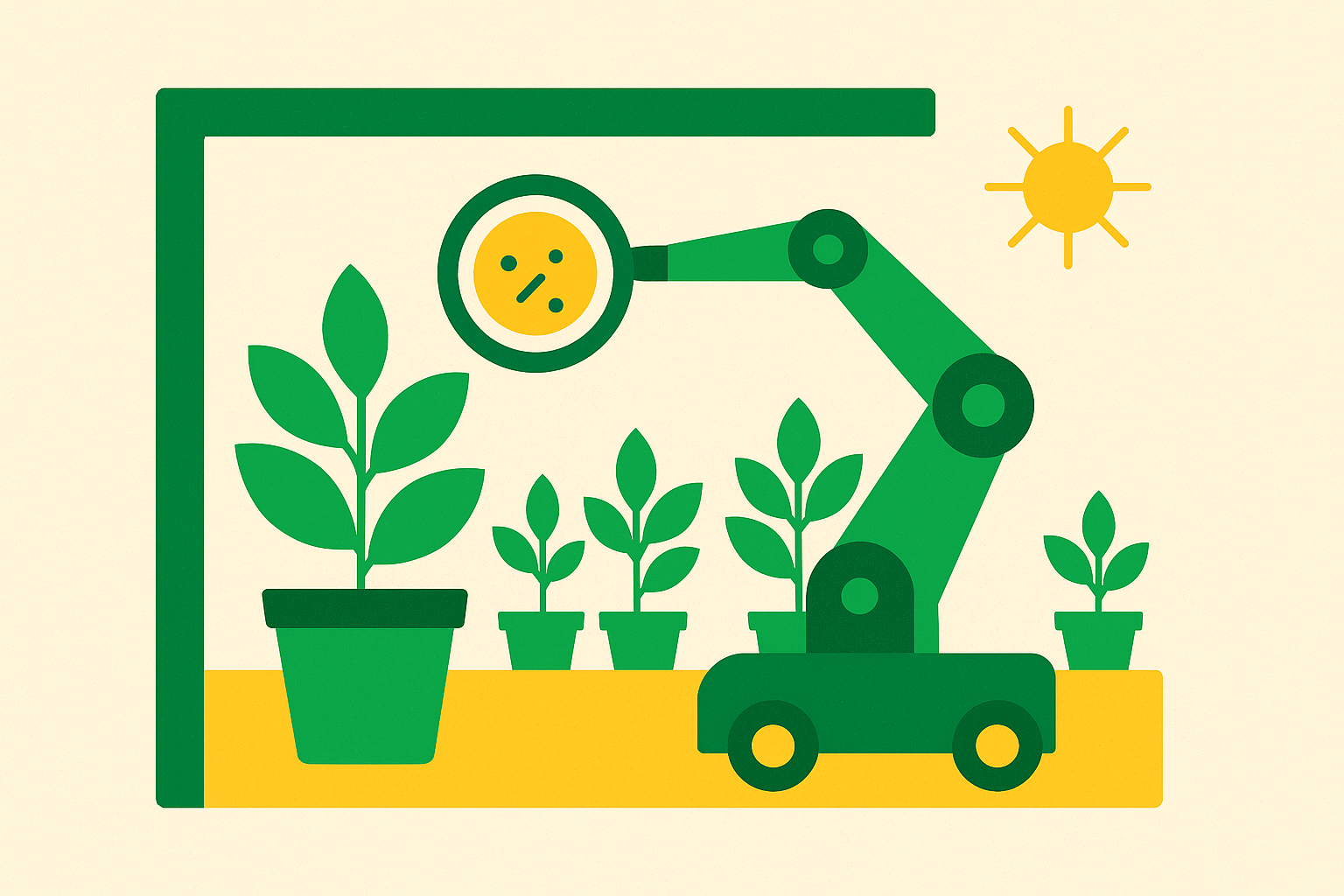
Controlled environment agriculture runs on data it can't collect fast enough by hand. Phenotyping robots close that gap by combining autonomous navigation, sensor fusion, and automated analysis to capture plant trait measurements at a pace no clipboard-and-caliper routine, and no fixed camera rig on its own, can match. The two hardware philosophies built to close that gap aren't interchangeable, and picking wrong costs a facility real throughput. What follows is why the gap opened up, how the two approaches actually differ, and what a validated system looks like once it's running on a real facility floor.
Why CEA operations are outgrowing manual phenotyping
Greenhouses, vertical farms, and hydroponic facilities promise something field agriculture can't: a growing environment where temperature, light, and humidity stay inside a set band all year. That control is what makes phenotyping, the practice of measuring observable plant traits like height, leaf area, canopy shape, and stress response, worth doing properly. When the environment holds steady, a change measured in the plant is more likely to trace back to genetics or a deliberate treatment than to noise from weather.
That's the opening controlled environments create. Researchers can watch the same plants across their entire developmental arc, which makes time-series trait data achievable in a way open fields never quite allow, but only if data collection keeps pace with how fast the plants are actually changing. Plants change on their own timeline, not a technician's.
Manual phenotyping still leans on someone walking the rows with a notebook or a caliper, and that method is slow, dependent on whoever happens to be measuring that day, and nearly impossible to repeat at scale. Once a facility runs thousands of plants through multiple growth stages, walking the rows with a notebook cannot keep pace with the workload, and the phenotyping program turns into the bottleneck holding back everything downstream of it, breeding decisions, stress trials, yield forecasting.
Two fundamentally different ways to move sensors past plants
The field splits into two basic strategies, and most of the confusion around phenotyping hardware comes from treating them as the same problem when they solve different ones.
The first is plant-to-sensor. Plants ride conveyor belts and stop in front of fixed imaging stations; the sensors never move, the crop does. This fits high-volume operations where plants already sit on a mechanized layout as part of normal cultivation, so adding stop-and-scan stations extends an existing workflow instead of inventing a new one. Commercial versions already exist: LemnaTec's PhenoAIxpert HT runs automated carriers through configurable multi-sensor imaging stations with its own data management software, and PSI's PlantScreen2 line offers similar configurable, multi-sensor setups backed by database-driven handling.
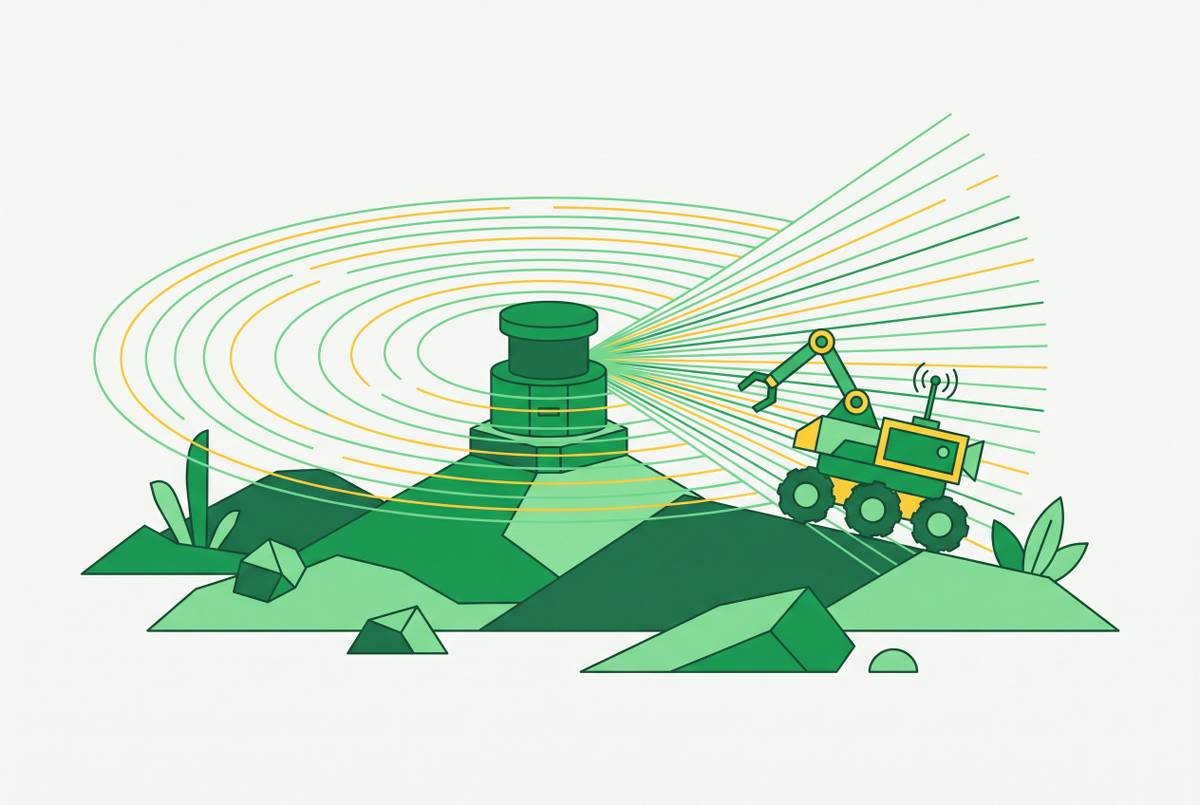
The second strategy flips the relationship: sensor-to-plant. Plants sit still and the sensing system does the traveling, using an autonomous ground robot working through greenhouse rows, or a gantry riding rails or a cart along the length of the facility. Texas A&M AgriLife runs a gantry installation that's a solid concrete example of the latter. Hybrids exist too: one open-source gantry design uses a single gantry paired with two separate manipulators, one working above the canopy and one below, to monitor and weigh soil-grown plants in vertical farming setups. Related variants have been designed to monitor crops in vertical hydroponic setups without disrupting them.
Most operators get the decision backwards: they ask which robot is more advanced, when the real question is what the building already looks like. Conveyor systems win on throughput and on keeping sensor geometry identical scan after scan, since the imaging station never moves and never needs recalibrating for a new position. Mobile and gantry systems trade some of that throughput for flexibility, reaching plants where they already sit without forcing a facility to redesign its cultivation layout around a conveyor. A facility built around a fixed, repeatable layout should run a conveyor, full stop. A facility with irregular rows, vertical hydroponic towers, or mixed crop sizes has no conveyor to build in the first place, and that's where mobile robots earn their keep.
The ceiling of conveyor-based phenotyping revealed by ORNL's APPL
The facility runs 520 trays, each holding either a single pot or up to 20 pots, giving it the capacity to handle as many as 10,400 plants inside one experiment, and it operates around the clock.
The sensor stack backing that scale is unusually deep for an automated greenhouse: dynamic chlorophyll fluorescence imaging to gauge photosynthesis efficiency, thermal imaging, near-infrared imaging, 3D laser scanning, and hyperspectral imaging, a combination ORNL's own researchers describe as among the largest arrays of imaging modalities ever assembled for plants in an automated greenhouse setting. Five distinct modalities running on a single conveyor platform is a genuinely large build, not a marketing figure.
No manual phenotyping program gets anywhere near that volume, and that's the entire point of APPL: it shows what the conveyor paradigm is for. Built for facilities that already move plants on a fixed, high-throughput layout, it shows what that architecture produces when pushed to its limit. But the same fixed layout is also the paradigm's ceiling. A conveyor moves plants to sensors; it cannot follow a robot into a bed of vertically stacked hydroponic towers or a greenhouse laid out in irregular rows. That's exactly the gap mobile robots exist to fill.
How mobile phenotyping robots solve the greenhouse navigation problem
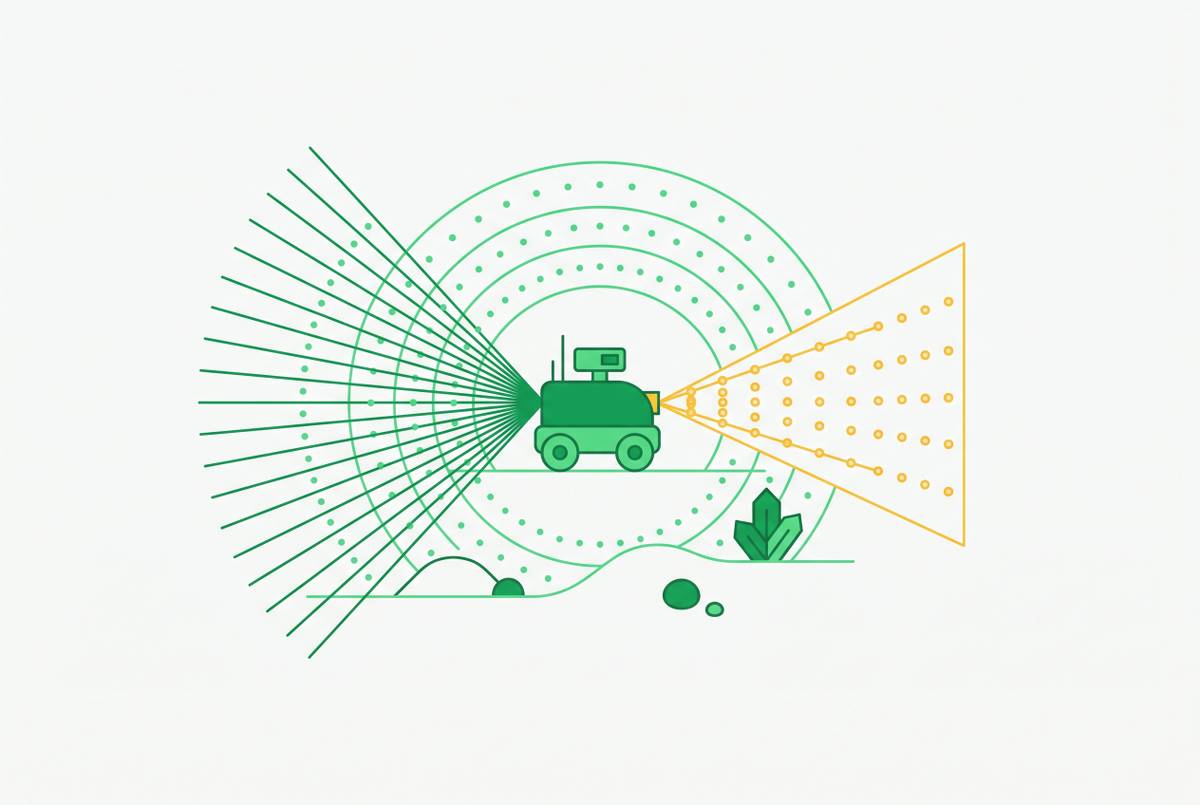
Moving the sensor instead of the plant raises a harder problem than throughput: navigation. Greenhouses are GNSS-denied environments, meaning satellite positioning can't give a robot reliable localization even with RTK correction layered on top. Narrow aisles, dense plant spacing, and constant occlusion from benches, irrigation lines, and support structures make the problem worse, not better.
Because pot layouts vary and plant-level data has to be traceable, the robot can't treat a row as a uniform, repeating structure the way a field robot might treat a corn row. It has to identify individual plants and tie each measurement to a specific specimen across multiple visits. Skipping that step causes a time-series dataset to collapse into a pile of disconnected snapshots with no way to link today's scan back to last week's.
LiDAR-vision fusion is a well-established engineering approach to this problem. LiDAR contributes structural mapping at the row level while camera vision supports finer plant-level targeting and sensor alignment. That division of labor matters more in CEA than out in an open field, precisely because pot layouts aren't uniform and the robot has to treat each plant as its own object rather than a repeating unit on a grid.
PhenoRob-P: what a validated mobile phenotyping robot looks like in practice
A system out of Huazhong Agricultural University, published in Plant Phenomics, shows what this architecture looks like once it's built and tested rather than theorized.
The chassis is a compact two-wheel differential platform, sized specifically for greenhouse aisle constraints rather than borrowed from an outdoor field robot. On top of that sits the LiDAR-vision fusion framework already described, handling row-level navigation while cameras take over pot-level targeting and alignment. A six-degree-of-freedom robotic arm, using inverse kinematics to compensate its pose in real time, makes repeatable close-range, multi-view imaging possible. As the chassis moves, the arm adjusts continuously to hold sensor-to-plant geometry steady, the same requirement flagged above in navigating tight aisles. That arm carries an adaptive multi-view phenotyping module built to support a range of sensor payloads, and the whole system reports back through a three-tier User-Cloud-Robot platform handling task scheduling, remote monitoring, and closed-loop data management, tying the physical robot to cloud analytics and to whoever is watching the dashboard.
The published numbers back the design up. The robot runs 520 pots per hour in continuous scanning mode, dropping to 187 pots per hour when switched into multi-view fine inspection mode. That drop is the tradeoff made visible: speed for detail, and a well-run facility picks the mode based on what the experiment actually needs that week, not by defaulting to whichever number sounds better in a spec sheet.
The sensor stack: each modality measures something different, and no single sensor suffices
None of this hardware matters without sensors that capture something biologically meaningful, and no single sensor covers the whole picture. Every modality on these platforms fills a gap the others leave open.
RGB cameras are the workhorse: cheap, easy to bolt on, good enough for general morphological reads like leaf area, canopy shape, and color indices. Their limit is spectral. An RGB image only sees what the human eye sees, so it can't catch a stress response before the plant visibly wilts or yellows.
Multispectral and hyperspectral sensors pick up where RGB stops, reading spectral bands tied to pigment concentration, water content, and nutrient status, often well before any of that shows up on a camera or to a person standing over the tray. The cost is complexity: hyperspectral data needs heavier calibration and processing than an RGB feed does. The payoff can be striking. Research applying regularized linear discriminant analysis to hyperspectral data has reached up to 99.6% accuracy differentiating five industrial hemp cultivars.
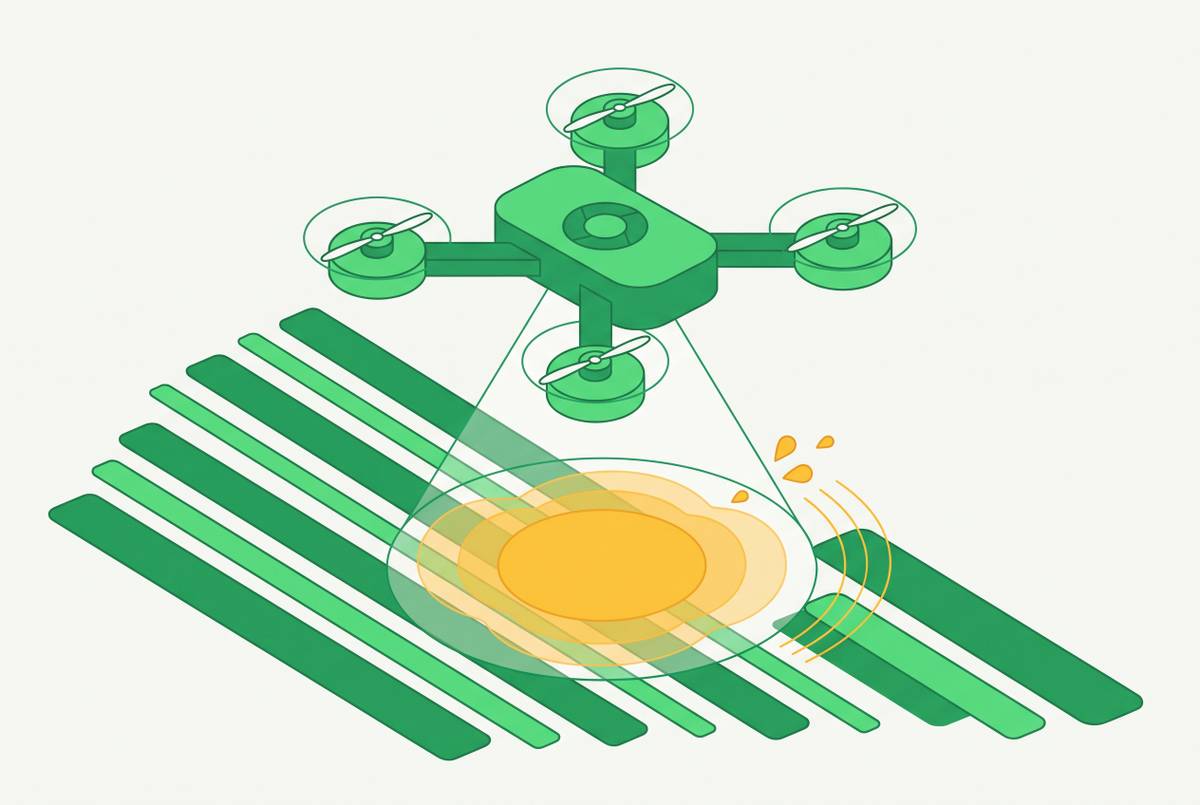
Thermal infrared imaging fills a third gap, reading canopy temperature as a non-invasive stand-in for water stress and transpiration rate. Ambient conditions can throw the readings off, so thermal imaging is most trustworthy where background temperature holds steady, and that describes CEA far better than it describes an open field. ORNL's APPL runs thermal imaging as one of its five core modalities for exactly this reason: a stable indoor environment is where the sensor performs best.
Facility design, modular architecture, and phenotyping robot capabilities
The greenhouse itself, not the robot, is the hardest part of this engineering problem. It's cluttered, humid, lit unevenly by shifting shadows, laid out in tight aisles, and stocked with crops of wildly different sizes and growth habits, sometimes within the same row. A phenotyping robot has to navigate that mess reliably, identify individual plants inside it, and hold sensor geometry steady enough to make this week's scan comparable to last month's.
The architecture choices covered here, conveyor versus mobile, single-sensor versus fused stack, fixed imaging station versus arm with real-time pose compensation, don't reduce to picking a favorite. They come down to matching the machine to the building it has to work in. A facility running thousands of pots through a repeatable layout gets more out of a high-throughput fixed-platform system like APPL's. A facility that can't offer that layout in the first place has no business trying to force one, and a mobile platform is the only honest answer. Either way, the sensor stack riding on top, RGB, hyperspectral, thermal, or some working combination of the three, decides what the robot can actually see once it gets where it's going.
Sources
- PhenoRob-P: An autonomous robotic system for high-throughput phenotyping of potted plants
- Optimizing Crop Production With Plant Phenomics Through High‐Throughput Phenotyping and AI in Controlled Environments - Kaya - 2025 - Food and Energy Security - Wiley Online Library
- pmc.ncbi.nlm.nih.gov
- ornl.gov
- academia.edu