Regulatory Pathways for Agricultural Robot Operation in the EU and US
EU and US regulators scramble to govern machines that outpace the laws designed to control them.
A robotic sprayer is threading between rows of vines, adjusting its own path as it goes. A harvester is recalculating its route in real time based on yield sensors nobody is watching. None of this is a pilot program anymore.
The rules meant to govern this equipment were not written with any of it in mind. Machinery safety law assumed a seat and a set of hands on a wheel. Occupational health law assumed a supervisor could see the worker. Pesticide regulation assumed a human being decided when to spray and where. Aviation rules assumed a pilot kept the aircraft in sight. Every one of these frameworks predates the machine now expected to comply with it, and that mismatch will not close on its own as agencies catch up. It is structural, built into the fact that legislation moves in years and product cycles move in months.
Both the EU and the US are confronting this same retrofit problem, but from different starting positions and with different tools. The EU is layering new, purpose-built instruments on top of the old machinery and safety directives, so that a single robot now has to satisfy several overlapping regimes at once. The US, by contrast, has largely left its fragmentation in place and let individual agencies stretch their existing authority to cover the new equipment, agency by agency, without a coordinating framework tying it together.
For anyone actually manufacturing or operating this equipment, the practical result is the same in both places even if the mechanics differ: there is no single rulebook to consult. Compliance has to be assembled, piece by piece, from multiple frameworks that sometimes complement each other, sometimes overlap, and sometimes simply leave a hole where no rule applies. Understanding which framework governs which part of the operation, and where the frameworks stop covering ground, is the actual work ahead of both manufacturers and the farmers deploying their equipment.
The EU's three-instrument layered governance of autonomous agricultural machinery
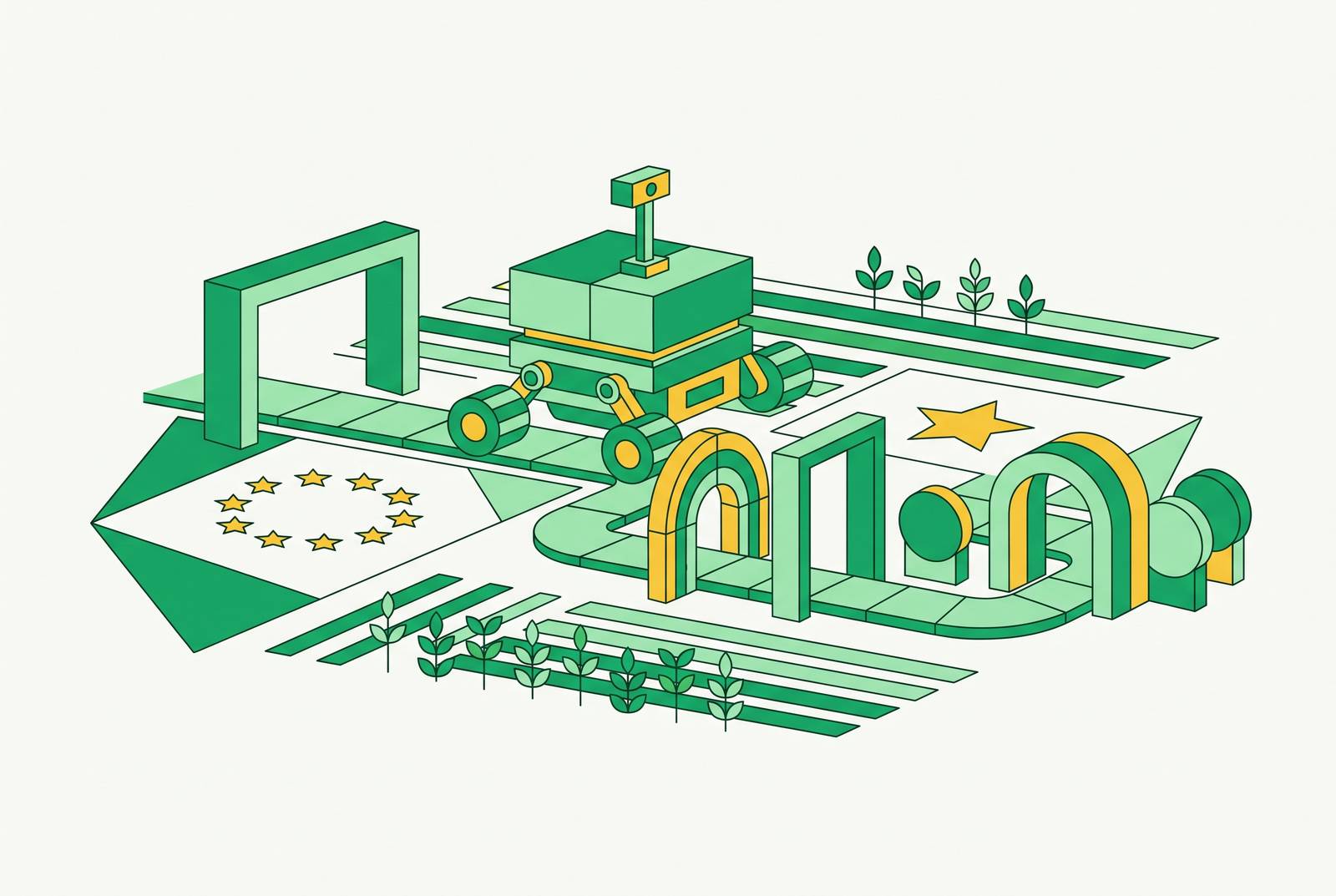
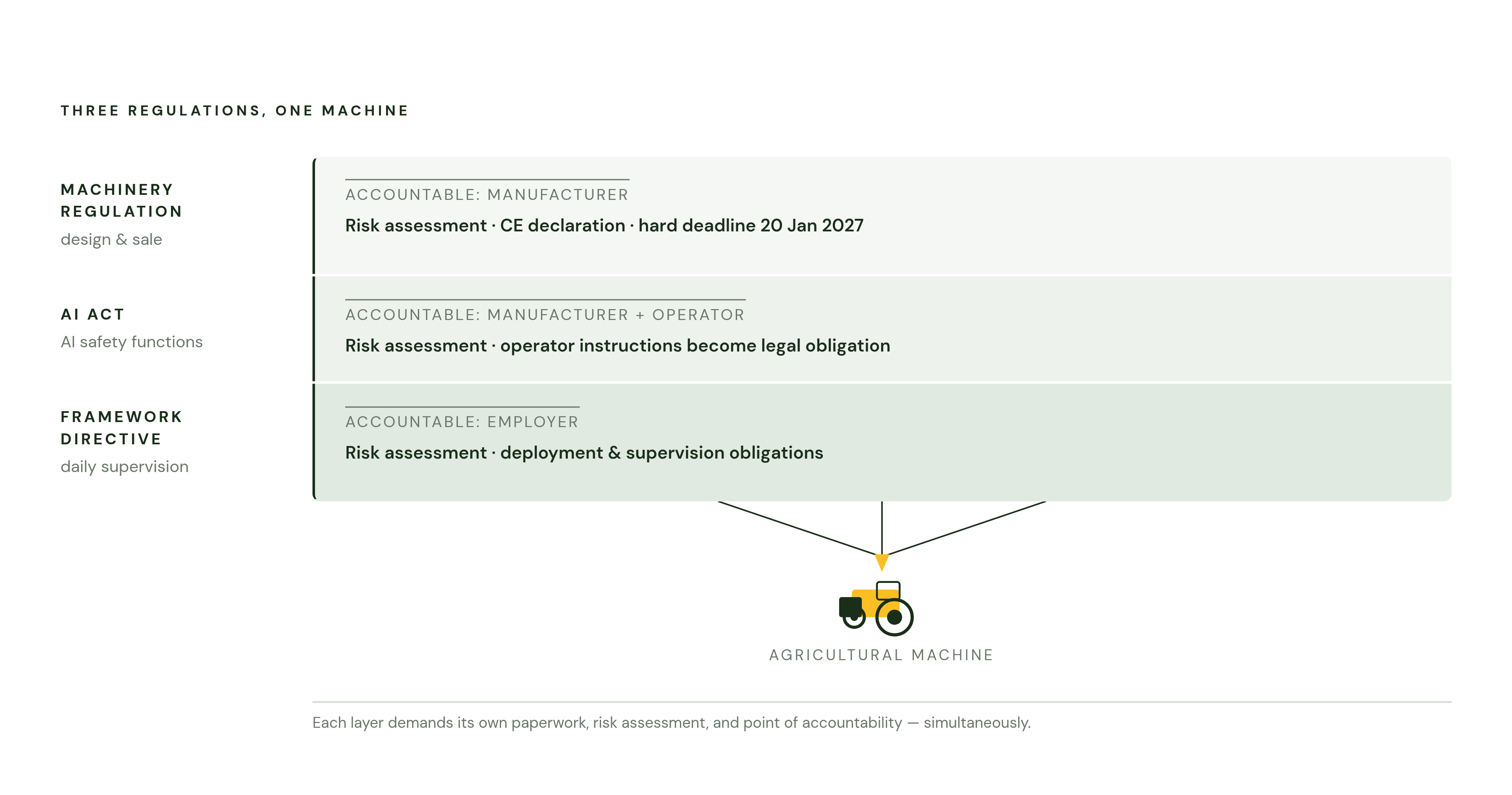
The EU did not write one new law for agricultural robots. It built a stack. Three instruments now apply simultaneously to any agricultural robot on the EU market, and each one applies at once.
The first instrument is the Machinery Regulation, which governs the manufacturer at the point of design and sale.
Read separately, each instrument looks manageable. Read together, they describe a single compliance burden that touches design, deployment, and daily supervision all at once, and a manufacturer or farmer who treats any one of them as the whole picture is going to miss obligations imposed by the other two. That is the real shape of the EU's approach: not a clean, unified code but three legally distinct regimes converging on the same tractor, sprayer, or harvester, each demanding its own paperwork, its own risk assessment, and its own point of accountability. Instrument three, the Framework Directive on occupational safety.
EU Compliance Demands for Manufacturers and Operators Starting January 2027
The date matters. Machinery placed on the EU market from 20 January 2027 onward has to conform to the Machinery Regulation; before that date, the older Machinery Directive still governs. That deadline gives manufacturers and operators a fixed, near-term point at which the compliance bar rises.
For manufacturers, the list of new obligations is longer and more demanding than anything the old directive asked for. Any autonomous machine with AI safety functions now has to go through third-party certification by an EU Notified Body, since self-certification is no longer available for this category of equipment. Risk assessments can no longer be a one-time exercise performed before the machine ships; they have to account for how the machine's behavior might change as its AI keeps learning and updating over the product's working life. Cybersecurity gets folded into functional safety directly: the software update process, any remote access into the machine, and its data logging all have to be hardened against interference that could alter how the machine behaves around people. Every machine needs always-on detection of people and obstacles, plus a supervisor interface that can stop it, restart it, or move it to a safe position at any moment. And documentation has to be kept digitally for a set retention period: if someone modifies the machine after delivery in a way that changes its safety behavior, that person, not the original manufacturer, inherits both the legal status of manufacturer and the liability that comes with it.
Farmers and operators face a separate, five-step list of their own, drawn from the BKT/S2 compliance guidance. Before deploying any autonomous machine, an operator has to run a formal risk assessment covering not just the equipment itself but every person who might come near it: workers, contractors, visitors, and any scenario where a person entering the operational zone could get hurt. Operating zones and protocols need to be written down and actually communicated, through physical barriers and direct instruction. Operators have to name and train specific supervisors who can carry out the supervisory function the Machinery Regulation requires: someone accountable by name. Documentation has to be kept and understood well enough that, if an accident happens, the operator can pull the machine's own decision logs and actually interpret them, because those logs are the primary evidence in any investigation. And operators have to track manufacturer updates and revised risk assessments as they come in, because the AI Act turns compliance with the manufacturer's instructions into a legal obligation in its own right; ignoring a safety-relevant software update can put an operator in breach of EU law even if the machinery itself never changes.
None of this is coming from critics outside the industry. CEMA, the European Agricultural Machinery Association, has itself asked regulators to clarify how the framework applies to robots working in open fields and to make sure the digital and connectivity infrastructure automation depends on actually gets built. When the trade body representing the manufacturers says the picture isn't finished, that is a reasonable signal that what follows, the actual gaps in the framework, is not a manufactured complaint.
The gaps the EU framework leaves for manufacturers and operators
Stacking three instruments closes a lot of ground, and understanding each one separately understates the compliance burden because all three apply at once. The gaps that remain are not obscure edge cases confined to unusual equipment; they sit squarely inside configurations that are already common on farms.
Picture an automated weed-removal unit: a metal box frame on wheels, no seat, no cab, packed with sensors, onboard computers, and a robotic arm that picks weeds out one by one. It isn't a tractor. But under existing categories, it isn't clearly anything else either, which leaves open the basic question of which compliance pathway even applies to it. The Machinery Regulation does address autonomous mobile machinery in general terms, but it does not settle which compliance pathway applies to every genuinely novel platform, and researchers had already flagged this as a structural weakness in EU machinery law well before the new regulation was drafted.
The liability gap runs deeper. The EU had proposed an AI Liability Directive in 2022, meant to work alongside the AI Act and the Product Liability Directive, and it would have given plaintiffs a right to access documentation on how an AI system actually functioned, which is the evidence needed to establish a duty of care in court. That directive was scrapped in 2025. Without it, whether an injured party can actually get their hands on the records needed to prove negligence against an autonomous machine's operator or manufacturer is genuinely unsettled; the Machinery Regulation's data-logging requirements generate the records, but whether courts will treat them as admissible or accessible in a civil claim has not been tested.
Enforcement is thinner than the paperwork suggests. The AI Act's accountability structure looks complete on the page, but as of early 2025, only three of the EU's twenty-seven member states had actually designated both of the national authorities the Act requires for enforcement. Researchers studying the rollout describe the enforcement architecture as showing signs of serious strain. The obligations imposed on farmers and manufacturers are real and binding, but the capacity to actually investigate a breach varies sharply depending on which country the farm happens to sit in.
And there is a gap that has nothing to do with safety at all: no mandatory environmental risk assessment applies to agrifood AI systems. That is a strange omission for an industry regulators have historically watched closely for ecological reasons, especially given the mechanism at work: the same precision spraying and irrigation systems that can cut pesticide and water use can also, by lowering the cost and exposure risk of each application, make it easier to apply chemicals more often, not less.
The fragmented, agency-specific US governance of agricultural robots
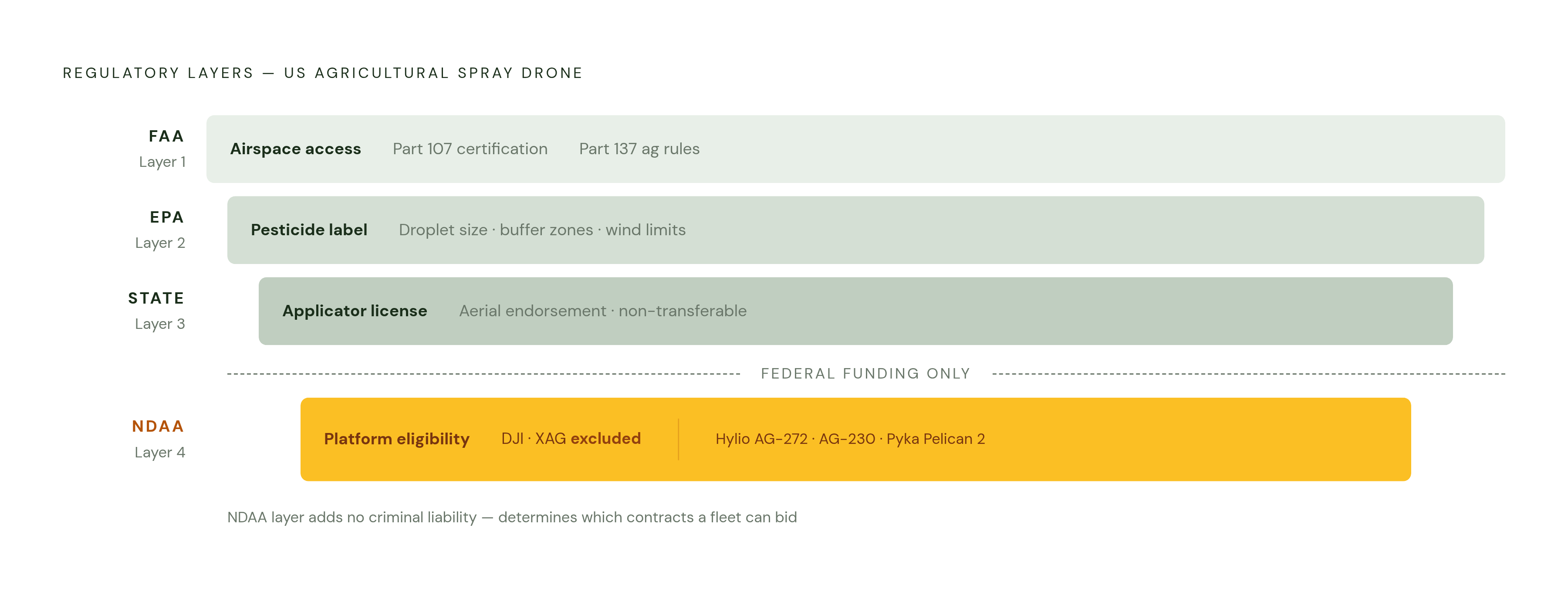
The US never attempted the EU's stacking exercise. There is no unified federal framework for agricultural robots, and OSHA says as much directly: it has no specific standards written for the robotics industry. What exists instead is a set of agencies, each with genuine jurisdiction over one slice of the operation, all of which can apply to the same piece of equipment at the same time.
Spray drones make the fragmentation easiest to see, because three separate federal agencies govern the same flight. The FAA controls airspace access and aircraft certification, through Part 107 for remote pilot certification and Part 137 for agricultural aircraft operations, the latter carrying its own separate rules for applying pesticide from the air. The EPA governs the pesticide label itself, and the label is federal law: it fixes carrier volume, droplet size, buffer zones, and wind limits, and those numbers constrain how the drone can fly no matter what the FAA has authorized. State departments of agriculture add a third layer on top, issuing the commercial pesticide applicator licenses and aerial endorsements a drone operator needs, and those licensing requirements differ enough from state to state that a license valid in one state does not automatically carry over to the next.
Ground equipment gets even less structure. There is no federal standard covering autonomous tractors or sprayers on the ground at all; it falls to state occupational safety law, and the results vary widely depending on which state a farm happens to sit in.
A fourth layer cuts across all of it whenever federal money is involved. Any work touching federal contracts, USDA-funded research, or state programs tied to federal dollars has to meet NDAA compliance requirements, and the practical effect is that certain platforms get excluded outright. DJI and XAG drones remain legal for private commercial spraying, but they are shut out of most federally funded work under NDAA rules. Among the platforms identified as NDAA-compliant for 2026 are the Hylio AG-272, the Hylio AG-230, and the Pyka Pelican 2. For an operator choosing equipment, that distinction is not a footnote. It decides which contracts a fleet is even eligible to bid on.
The BVLOS rulemaking and the Cal/OSHA variance: where US purpose-built rules are beginning to appear
The US system is not frozen. Purpose-built rules are starting to appear, though the process moving them forward is slow, handled case by case, and prone to leaving its own gaps behind as it goes.
The clearest movement is happening at the FAA. On 7 August 2025, the FAA and TSA jointly published a Notice of Proposed Rulemaking titled "Normalizing Unmanned Aircraft Systems Beyond Visual Line of Sight Operations," and agriculture and aerial surveying are named directly among the target use cases. An executive directive tied to the effort instructed the FAA to issue the Part 108 proposed rule within a short initial window and finalize it within a longer deadline set after that. Until that rule is finalized, any large-scale drone spraying operation that needs the aircraft to fly beyond the pilot's direct line of sight sits in a legally uncertain position, dependent on waivers granted one operation at a time rather than a standing rule.
California offers the clearest example on the ground side. State rules require an operator stationed at the controls of farm equipment whenever it's running, a requirement with no allowance for a driverless machine built into it. Cal/OSHA worked around that by granting Monarch Tractor a five-year temporary experimental variance in 2021, a carve-out that expires in August 2026. It is a narrow fix, granted to one company, for one state, on a clock that is now running out, and it captures the US approach in miniature: real progress, but assembled one exception at a time rather than settled once for the whole industry.
Sources
- Autonomous Agriculture: A Farmer's Guide to Safety and Compliance | BKT Tires
- New EU Regulation for Agricultural Machinery: AGRICULTURAL ROBOTS Are Making Their Debut | BKT Tires
- (PDF) Legal Framework for Small Autonomous Agricultural Robots
- CEMA - European Agricultural Machinery - CEMA’s strategic role in advancing agricultural robotics and autonomous machines
- Farmers fuming over California's ban on driverless tractors, other robots
- The EU AI Act and the Food System: How the European Union Ai Act Applies to Agrifood | European Journal of Risk Regulation | Cambridge Core
- CEMA - European Agricultural Machinery - The new Machinery Regulation is published: new requirements and upcoming steps
- FAA's proposed Part 108 BVLOS Rule: Industry response and key concerns | DLA Piper