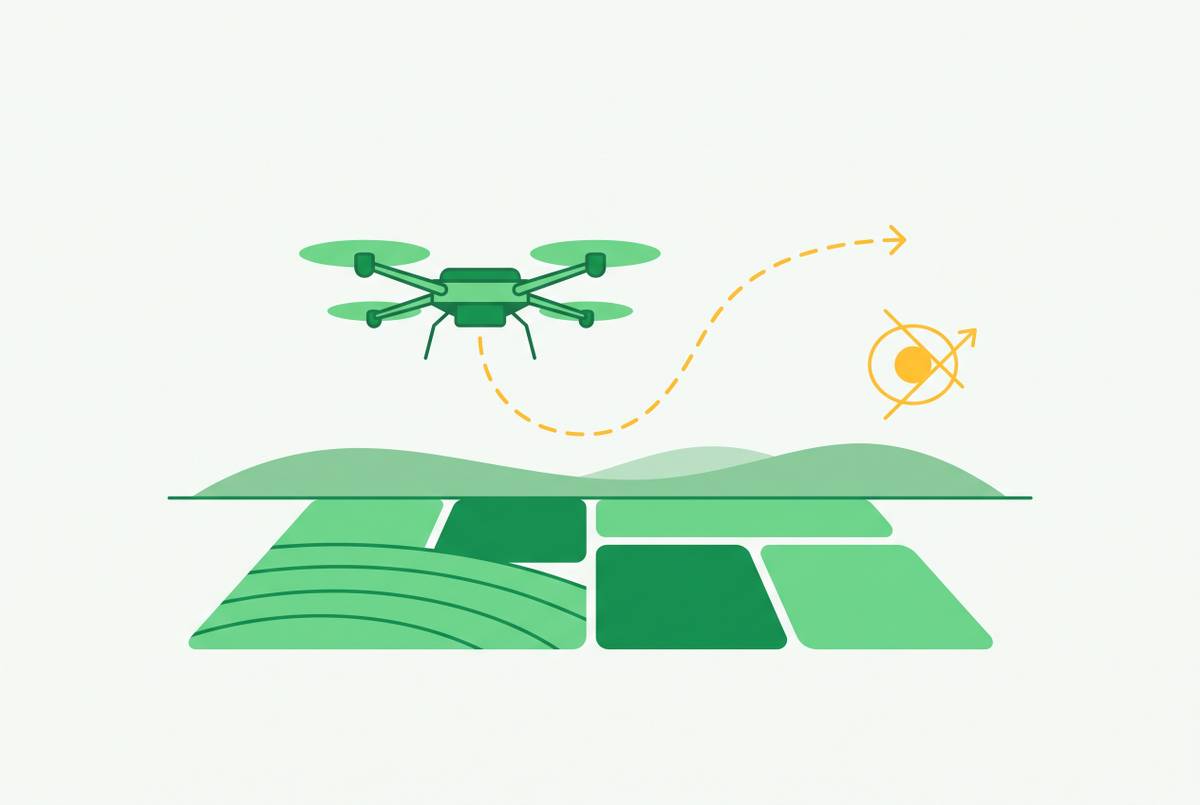
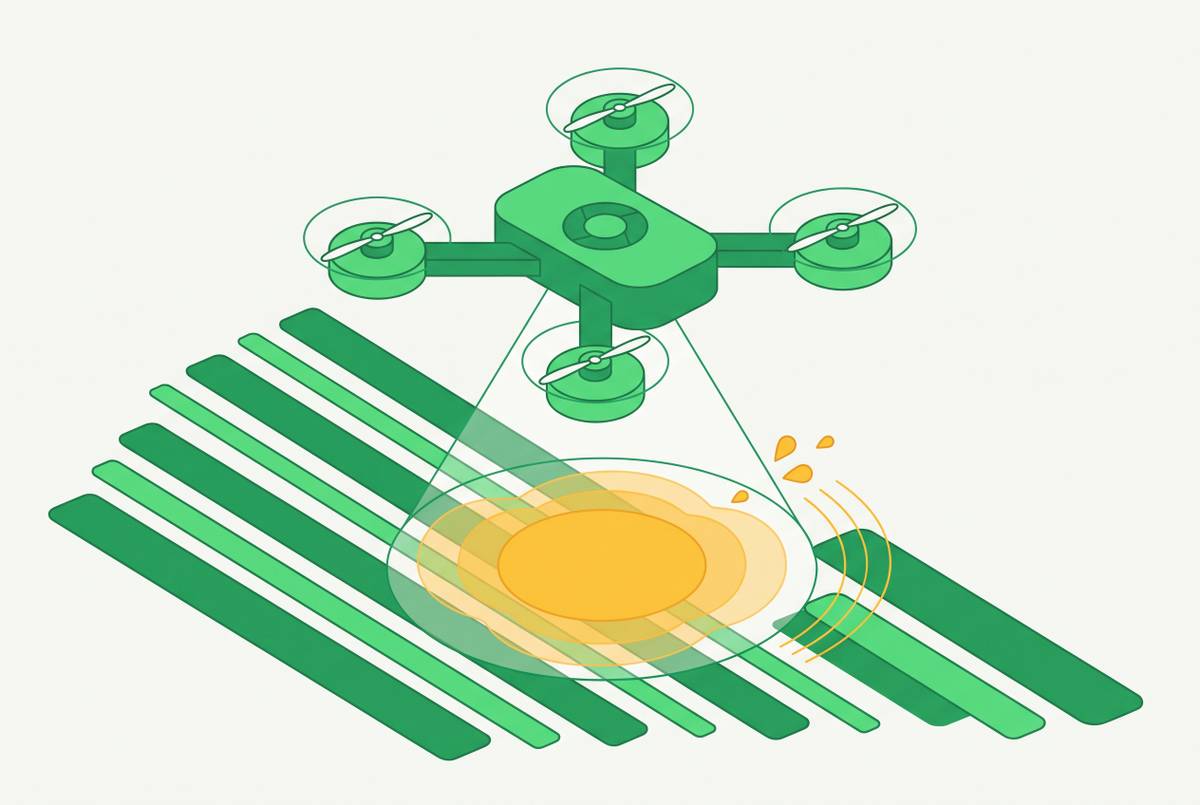
Multispectral vs. Hyperspectral Drone Sensors for Crop Stress Detection
Hyperspectral sensors identify what's wrong; multispectral shows where trouble is.
A field of yellowing leaves, thinning canopy, or patchy wilting can be drought, nutrient deficiency, fungal disease, or pest damage, and from a distance, the four can look nearly identical. That overlap is the problem this piece addresses: choosing between multispectral and hyperspectral drone sensors is really a question of which stress a grower needs to identify, and how precisely. The confusion isn't cosmetic. Treating a nitrogen-deficient field with fungicide wastes money and time, and irrigating a crop that is actually fighting disease delays the one intervention that would have worked. Research on multi-sensor stress detection has mapped out why this ambiguity exists at a physiological level: stress moves through phases tied to dose and duration, and each phase produces a different physiological signature, pigment changes, structural shifts in leaf tissue, loss of water content, and each of those signatures shows up in a different part of the spectrum, from visible light through near-infrared, shortwave infrared, and thermal. Catching the right phase means pointing a sensor at the right part of the spectrum. The choice of instrument isn't a matter of preference. It decides what a grower can and cannot see before yield is already lost.
Multispectral versus hyperspectral: what each sensor measures
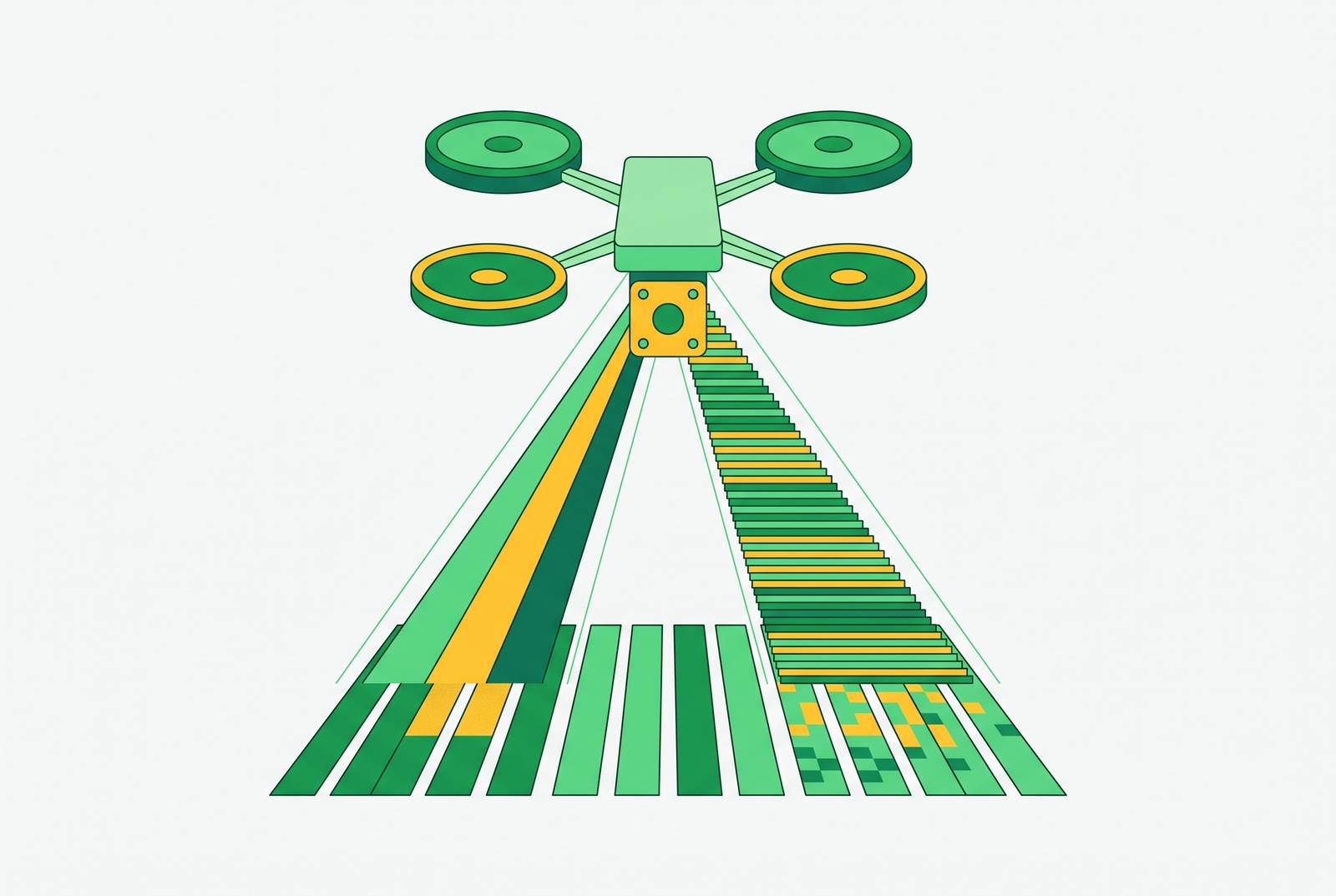
Multispectral and hyperspectral cameras sit at opposite ends of a single spectrum: how finely a sensor slices up the light reflecting off a plant. Multispectral cameras record a handful of broad, separate wavelength bands. Hyperspectral cameras record bands too, but they sweep them densely and continuously, so they cover a much wider range. It's a bit like hearing a chord, versus hearing each note inside it played on its own. A multispectral sensor hears the chord, enough to tell a grower that something in the mix has changed. A hyperspectral sensor hears each note, enough to say which one is out of tune.
Multispectral sensors measure plant reflectance in bands that are chosen because they line up with known physiological signals: chlorophyll absorption in the red band, cell structure scattering in the near-infrared. Combined, those readings become vegetation indices such as NDVI, which compress a plant's reflectance pattern into a single number tied to vigor. That number is useful precisely because it's simple: it can be computed quickly and mapped across an entire field. But it also means that two very different biochemical events, say a drop in chlorophyll from disease and a drop in chlorophyll from nitrogen shortage, can produce the same drop in NDVI. The index cannot see past the symptom to the cause.
Hyperspectral sensors avoid that compression because they capture a near-continuous reflectance curve for every pixel, running from the visible range through the shortwave infrared. That full curve carries narrow spectral features tied to specific biochemical constituents: particular pigments, water absorption bands, compounds in plant cell walls. Those features are so narrow and so specific that a broad-band multispectral sensor often can't pick them out. An original research article in Frontiers in Plant Science describes hyperspectral methods as highly sensitive and accurate, and notes that both multispectral and hyperspectral approaches can flag plant stress earlier than a human scout or a traditional lab assay can. The real distinction between them, the article notes, is not just how early each one catches a problem but how specifically each one can name it. A December 2025 review in Smart Agricultural Technology frames the spectral dimension, alongside angular and spatial dimensions, as one of several complementary axes in crop sensing, and it is the axis on which these two sensor types diverge the most sharply.
What multispectral sensors reliably detect
Multispectral drones earn their keep on tasks that reward coverage over precision: field-scale health monitoring, canopy vigor mapping, and flagging broad abiotic stress patterns like drought or a general nutrient shortfall. These are jobs where a grower needs to scan hundreds of acres quickly and consistently, not resolve a single leaf's biochemistry. A December 2025 review in Smart Agricultural Technology documents multispectral UAV use across crop monitoring, fertilization guidance, and stress zone identification, confirming that this is now standard, operational work in precision agriculture, not an experimental add-on.
The clearest field demonstration of what multispectral can do comes from the University of Idaho, where researchers used a Parrot Sequoia multispectral camera mounted on a Solo drone to detect drought stress in Russet Burbank potato plants. The system could tell healthy from stressed plants at the individual plant level, under real field conditions, not a lab bench. Paired with deep learning, multispectral imagery handled a specific abiotic stress recognition task reliably enough to automate it at field scale.
But the same broad bands that make multispectral fast and cheap also make it blind to certain distinctions. Early fungal infection and iron chlorosis can both suppress NDVI by roughly the same amount, so when that happens, multispectral data can't tell a grower which one it's looking at. The Frontiers review states that multispectral imaging works with discrete wavelength bands and carries reduced spectral resolution relative to hyperspectral, so some diagnostic detail passes through unnoticed. You can use multispectral data to guide variable-rate input decisions, and it can point scouts toward trouble spots. It flags where to look. It does not, on its own, say what's wrong.
What hyperspectral sensors can identify that multispectral cannot
Where multispectral answers "where is stress present," hyperspectral is built to answer "what is causing it." That distinction is the whole case for paying hyperspectral's higher cost. Plant stress research on multi-sensor detection notes that stress under short-term, medium-term, or severe chronic conditions produces distinct physiological responses, through light absorption and scattering processes that span the visible, near-infrared, shortwave infrared, and emitted domains such as fluorescence and thermal signal. Capturing several of those phases at once calls for spectral coverage that only a hyperspectral sensor provides.
The Frontiers in Plant Science review describes a capability multispectral sensors cannot approach at all: asymptomatic detection, identifying disease before any lesion is visible to a camera or a scout. That capability rests on resolving sub-clinical shifts: small changes in pigment ratios and early changes in leaf water content, both of which occur before a plant shows any structural damage. A fungal infection that hasn't yet produced a visible lesion still alters a leaf's narrow-band reflectance signature well before it alters its broad-band signature.
That early read matters agronomically because it changes the timing of intervention. Catching a fungal or bacterial pathogen before it spreads visibly limits the window in which it can move through a field, which narrows both the eventual yield loss and the area that needs treatment. Multispectral data can tell a grower that a zone of the field looks weaker than its neighbors. Hyperspectral data can tell a grower, before that weakness is even visible, which pathogen or deficiency is driving it.
The gap between laboratory accuracy and field performance
Every claim made so far holds up best in controlled conditions, and when both sensor types leave the lab, they lose ground. Deep learning models for plant disease detection that perform well in testing commonly see field deployment accuracy fall to between 70 and 85 percent. That drop isn't distributed evenly across sensor types: it lands harder on hyperspectral systems, because their calibration pipelines are more complex and more sensitive to shifts in lighting, humidity, and atmospheric conditions that a multispectral workflow can shrug off more easily.
The Frontiers in Plant Science review names the open problems directly: calibrating sensors reliably in changing field conditions, getting models to generalize across different species and environments, and building large enough annotated datasets to train on. These challenges sit across sensing and machine learning approaches broadly. Higher spectral resolution does not make them go away.
The way these studies get designed carries a built-in bias: researchers choose sensor combinations based on availability and cost, not on diagnostic completeness. Study designs were shaped by what sensors were available and what they cost, and that is why combinations of visible, near-infrared, and thermal imaging appear far more often in the literature than full hyperspectral setups, the Remote Sensing of Environment review notes. Researchers default to simpler sensor combinations, which suggests that field-ready hyperspectral workflows haven't displaced them where it counts. Nearly every reviewed study also restricts data collection to clear-sky, low-wind conditions to keep reflectance readings stable, a scheduling constraint that applies to both sensor types but costs hyperspectral more, since its radiometric calibration has less tolerance for deviation.
None of this erases hyperspectral's causal advantage. It does mean that advantage shrinks once a sensor leaves the test plot, and that a multispectral system's simpler calibration is not merely a cruder version of the same thing. Multispectral is a tool fitted to the resolution you can actually sustain in a routine field deployment. A field that looks uniformly stressed to a multispectral sensor might hide two or three distinct problems, and only hyperspectral could tell them apart. For most of the decisions growers make day to day, where to send a scout, where to apply a treatment, multispectral's ability to localize a problem is good enough, even when its ability to name the cause is not.
The cost, payload, and processing burden that governs which sensor a real operation can use
Diagnostic capability rarely decides which sensor a farm actually uses. Cost, weight, and data handling usually decide first. Hyperspectral systems cost more to buy, weigh more on a drone, and demand far more computing power to turn their output into a usable map, and these three burdens compound each other.
The cost gap alone is steep. Hyperspectral camera prices run from entry-level units up to high-end research and industrial systems that can exceed six figures, but a capable multispectral package costs a fraction of that. For a smallholder farmer or a mid-sized row-crop operation, that gap settles the question before you even get to a spectral argument. Weight adds a second constraint. A December 2025 review in Smart Agricultural Technology identifies payload capacity as a critical limit on drone sensing, one that forces a trade-off between how much sensor capability a drone carries and how long it can stay in the air, whether the payload is multispectral, hyperspectral, LiDAR, or thermal equipment.
Data processing closes off the third angle. Hyperspectral imagery produces enormous volumes of data, and pulling a useful diagnostic index out of hundreds of contiguous bands takes computing infrastructure and specialized expertise that most farm operations don't keep in-house. The Frontiers review describes this directly: hyperspectral methods generate data volumes that demand sophisticated computing software to process. Multispectral workflows clear that bar far more easily: they produce usable vegetation index maps within hours of a flight, using software that's already widely available, and that turnaround actually fits the pace at which agronomic decisions get made.
This is where service providers change the calculation. A company that owns the drone, operates the sensor, handles calibration, and processes the data removes the cost and payload burden from the grower's side of the ledger entirely, and that shift is what makes a more capable sensor tier reachable without requiring every farm to build its own remote sensing department.
Phantom Farm and other drone analytics services growers can use without owning the hardware
For most growers, the real decision is which service can deliver the right diagnostic answer for the problem in front of them, not which camera to buy. Phantom Farm fits that need directly: rather than asking a grower to weigh the cost, payload, and processing trade-offs described above, it takes on the sensor operation, calibration, and data processing itself, and matches the sensor choice to the diagnostic task at hand, whether that's a broad health map across a full field or a targeted search for a specific stress signature. That structure is well matched to the realities already laid out here. A grower can get hyperspectral-level diagnostic specificity for a targeted problem without carrying the six-figure equipment cost or building an in-house data science team, and can still use simpler multispectral flights for routine, field-wide monitoring where that level of detail is all a decision needs.
Growers encounter other paths to this same data, though most are narrower in scope. General agricultural drone operators offer multispectral flights as a standalone service, so it works for a one-off vigor map, but it skips the broader diagnostic matching a dedicated analytics service provides. Research institutions and extension programs sometimes make hyperspectral flights available for trial or demonstration purposes, which can be a useful way to see what the technology offers but isn't built for repeated, operational use across a growing season. Set against those options, a service built around matching the sensor to the question, instead of offering a single fixed flight product, solves the sensor-selection problem for the grower.
Sensor fusion and miniaturization as the direction the field is moving
The sharp line between multispectral and hyperspectral is likely to blur, not harden. Payload constraints are a major reason growers still have to choose one sensor type over another on a single drone flight, and that constraint is a function of current hardware size and weight, not a permanent law of drone design. As multispectral, hyperspectral, thermal, and LiDAR sensors shrink and lighten, carrying more than one on a single platform becomes more realistic, which would let a single flight gather both the broad coverage multispectral provides and the narrow-band specificity hyperspectral provides.
Sensor fusion is that combination, and researchers are already pointing toward it, even though you can't get it routinely on farms today. The frameworks described above are built around VIS-NIR-TIR combinations chosen partly for cost and availability, and they hint at where fused systems are headed once hyperspectral components shrink enough in price and weight to travel alongside simpler sensors as standard equipment, not a specialized add-on. Until that shift plays out, growers and agronomists still have to choose between multispectral's coverage and hyperspectral's specificity if they want to catch crop stress before it costs them yield.
Sources
- Frontiers
- Multi-sensor spectral synergies for crop stress detection and monitoring in the optical domain: A review - ScienceDirect
- Potato Crop Stress Identification in Aerial Images using Deep Learning-based Object Detection
- Multi-dimensional optical remote sensing in agriculture: Spectral, angular, and spatial scaling for crop stress monitoring - ScienceDirect