Hydraulic vs. Electric Actuation in Heavy Agricultural Robots
Hydraulic systems dominate heavy lifting, but electric actuators win on efficiency and precision.
Choosing between hydraulic and electric actuation in a heavy agricultural robot is a decision that has real engineering consequences. It is a decision that has to be weighed against four tradeoffs that behave differently in this environment than anywhere else in robotics: force density, precision, field serviceability, and energy efficiency. The stakes are getting bigger every year. Mordor Intelligence projects the agricultural robots market will grow from USD 15.2 billion in 2025, and USD 18.0 billion in 2026, to USD 41.3 billion by 2031, an 18.07% compound annual growth rate over that back half of the decade. More than a billion dollars poured into harvesting and weeding startups alone between 2022 and 2025. Design choices that used to unfold over a couple of decades of tractor development cycles are now getting compressed into a few product generations. Market sizing estimates vary a lot across research firms depending on how they define the category, so this piece sticks with Mordor Intelligence's agricultural robots figures throughout, for consistency. Hydraulic and electric actuation each bring real, defensible advantages to this environment. Understanding where each one wins, and why, is what separates a deliberate engineering decision from a default inherited from some other industry's playbook. Hydraulic vs. Electric Actuation in Heavy Agricultural Robots.
Demands of the heavy agricultural robot actuation environment
Heavy agricultural robots are their own category, distinct from industrial arms bolted to a factory floor or humanoid platforms built for indoor, climate-controlled spaces. Autonomous tractors, robotic weeders, and AI-powered harvesters all operate outdoors, on unstructured and constantly shifting terrain. That terrain alone demands continuous high-torque output and the kind of shock absorption a factory robot never has to think about. Duty cycles run for a full field season, not an eight-hour shift, and when something breaks, there's rarely a clean room or a specialist bench nearby, sometimes not even a dealer within a few hours' drive. Dust, mud, standing moisture, and temperature swings that can span both sides of freezing in a single day create an operating envelope that would wreck a lot of conventional robotics hardware inside a season.
Fluid power has historically been the default for high-power off-road vehicles because of real advantages over other ways of transmitting power, as Purdue University research on agricultural hydraulics demonstrates. That's the incumbent baseline this whole comparison starts from. But it's not a clean either/or split in practice. A research review from Aitronik on modern heavy autonomous farm robots found that weeding, hoeing, and pruning tasks each place distinct demands on force, precision, and duty cycle, and machines increasingly mix hydraulic and electric actuators task by task rather than committing to one system across the whole platform. That mixing is the throughline for this whole piece: force density, positional precision, system-level energy efficiency, and field serviceability are the four lenses worth running every actuation decision through.
The hydraulic case: where fluid power still leads in heavy ag applications
Fluid power still wins on raw force density, and it's not close. Hydraulic actuators lift and hold heavy loads without needing a brake, move heavy loads at slow, controlled speeds, and generate torque without a gearbox, all while taking up less space and shedding less heat at the actuator itself compared to an equivalent electric motor. A hydraulic pump only needs to be sized for the average load across a task, whereas an electric motor has to be sized for the peak load it might ever see, which matters enormously when load profiles swing wildly across a growing season, as they do in tillage or loader work. Hydraulic systems also carry an accumulator that stores energy between motion cycles, so the advantage is sharpest in applications with intermittent rather than continuous motion, and a lot of implement work on a farm is exactly that: start, stop, reposition, repeat.
Field technicians tend to give a blunt answer: electric actuators are not going to replace the heavy hydraulic cylinders needed to move hay with a loader any time soon, because they're simply not built for that category of load. Power Motion Tech frames this as a live engineering constraint rather than an inherited habit: full electrification of heavy implements isn't feasible today because hydraulics still hold a clear power density edge over electric actuators. There's also an installed-base argument that's easy to underrate. Purdue University research shows that load-sensing hydraulic systems remain the fundamental operating principle behind the primary hydraulic circuits on agricultural tractors, despite plenty of advances elsewhere in the machine. And hydraulics tolerate the unpredictable stuff better, the binding events and sudden load spikes that appear in weed-root extraction, tillage, and loader work, in ways electric actuators generally don't handle as gracefully.
Load-sensing and electro-hydraulic valves in modern hydraulic efficiency and precision
The efficiency knock against hydraulics mostly targets an older generation of fixed-displacement systems, which limits how broadly that criticism applies today. Load-sensing hydraulic pumps adjust flow and pressure to match actual demand in real time instead of running at a constant fixed displacement, and that alone can cut fuel consumption by up to 30% compared to a conventional fixed-displacement setup. That gain is greatest where hydraulic demand swings hard within a single pass: boom sprayers that need varying flow to different sections of the boom, front-end loaders where demand spikes only during the lift and sits idle the rest of the time.
Precision has moved too, and it's moved further than most people expect from a fluid-power system. RTK-GNSS auto-steering on modern tractors hits accuracy of about ±2.5 cm, delivered through electro-hydraulic steering valves rather than an electric-only control path. That's precision agriculture's headline demand being met hydraulically. For a designer, this changes the calculus. The "hydraulics are inefficient and imprecise" argument really only holds against older, fixed-displacement systems. Once load-sensing and electro-hydraulic valves are in the picture, both objections lose most of their force.
The electric case: efficiency, cleanliness, and control architecture advantages
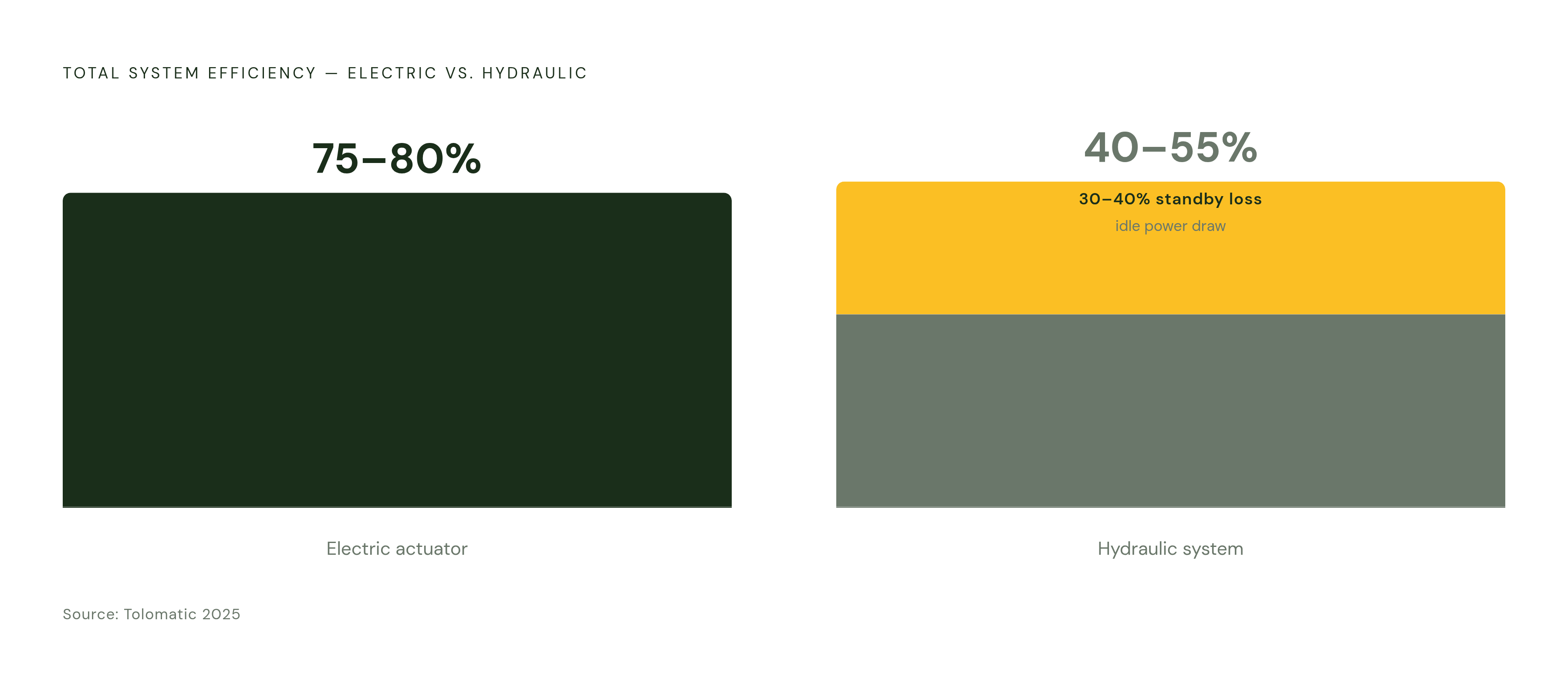
Electric actuation's efficiency case is not close either, just running the opposite direction. Schaeffler's figures show that only about 44 percent of the input power in a hydraulic system actually reaches the load, versus more than 80 percent in an electromechanical system. Tolomatic's 2025 numbers, reported by The Hoodland, are similar: electric actuator systems run at 75 to 80 percent total system efficiency, hydraulic systems typically run at 40 to 55 percent. Part of the gap comes down to standby behavior. A hydraulic power unit runs continuously to maintain system pressure, burning through 30 to 40 percent of full-load power even while the cylinder itself sits completely idle. Electric systems don't carry that tax, because the motor draws current only when it's actually doing work.
That gap turns into real money at scale. Then there's the cleanliness argument, which matters more in agriculture than in almost any other robotics domain: electric linear actuators use no fluid at all, so there's no leak risk, no soil contamination, and critically, no crop contamination risk in harvesting applications where the actuator sits close to food product. The architecture is simpler too. There are fewer components, no valves, no regulators, no hoses, no hydraulic power unit. That results in fewer failure points and an easier diagnosis when something does go wrong out in a field, far from a service bay. Christiaan Poot, Technical Support Manager at Miedema, the Dutch potato machinery manufacturer, said: "Wherever possible, we try to replace hydraulic systems with electric systems. Electric actuators do not have any problem with leaks. Maintenance is also much simpler."
The force ceiling that used to separate the two technologies is climbing fast, too. Precision has climbed right alongside force. Innovation Hub reports that direct-drive motor technology in modern electric actuators is hitting sub-millimeter positional repeatability, and next-generation servo motors are reportedly reaching repeatability down to 10 micrometers. Today's electric actuators are capable of exerting up to 100,000 lbs. Power Motion Tech reports that today's electric actuators exert up to 100,000 lbs of force, enabling competition with many hydraulic technologies in heavy applications, so the force gap is narrowing.
The Ceiling of Electric Actuation in Heavy Agricultural Robots Today
Battery energy density is the wall electric actuation keeps running into for heavy, full-season implements. Fresh Consulting reports that current lithium iron phosphate battery technology is limited on both energy density and recharge time, which makes it a poor fit for full-season heavy-duty field operations unless the machine is willing to stop midday to charge. Solid-state batteries are supposed to fix a lot of this: roughly double the energy density, faster charging, longer service life. But CATL and several other battery makers are only targeting small-scale production starting around 2027, so this is a real technology, just not one that's arrived yet at the scale heavy ag equipment needs.
Until battery technology improves enough to close that gap, all-electric heavy implements face a range-versus-payload tradeoff that hydraulic systems, drawing straight off a tractor's diesel tank, simply don't have to deal with. Loader arms, tillage implements, and baler compression are exactly the task categories field technicians flag as beyond what current electric actuators can reliably handle. There's a useful analogy from an adjacent field here. A systematic review of hydraulic legged robots, covering more than 35 robots across more than 70 articles and following PRISMA methodology, found that hydraulic actuation remains a critical enabler wherever a machine needs a high payload-to-weight ratio combined with dynamic capability. Heavy ag manipulators face the same physics. And thermal management is its own quiet constraint: electric motors have to be sized for the maximum load they'll ever see, and they can overheat under sustained high-torque demand, which is a real problem in continuous loader or tillage cycles where a hydraulic system just vents its heat out through the fluid instead.
The electro-hydraulic actuator as a design option for tasks that fall between the two extremes
An electro-hydraulic actuator, or EHA, is a self-contained unit: an electric motor drives a small hydraulic pump, which extends or retracts a hydraulic cylinder, all without an external hydraulic power unit or any centralized fluid routing across the machine. The pitch is straightforward. Agricultural deployments already back this up. HCI-CTEC documents compact EHAs with integrated position feedback used in section-control seeders and variable-density balers, with IP67-rated units suitable for dusty, wet field conditions. Because these units plug into ISOBUS, they sit inside the same precision agriculture data infrastructure the rest of the tractor and implement already use, rather than demanding a separate control system bolted on the side.
The legged-robot research mentioned earlier offers a useful parallel again. That systematic PRISMA review found centralized hydraulic power units deliver more total power, but their efficiency degrades as they try to scale across multiple joints at once. EHAs sidestep that problem entirely by putting power generation right at the point of use instead of routing it from a single central source. That's the design logic for where EHAs fit in a heavy ag robot: implement joints that need high, intermittent force paired with precise position feedback. Planter down-force control, baler compression, boom height management, these are the natural homes. Where EHAs don't make sense is anywhere a machine needs continuous high flow across a lot of axes at the same time, since that's exactly the scenario where a centralized hydraulic power unit's raw power advantage outweighs the efficiency it gives up. GlobalSpec states that the electro-hydraulic actuator's design proposition delivers the high force and durability of hydraulics with the precision and responsiveness of electronic controls, in a compact package that electromechanical alternatives cannot match in harsh environments.
The all-electric heavy-duty manipulator research frontier and its impact on electric-only systems
The technical content addresses several of the exact limitations electric actuation faces in the field today. The framework uses NSGA-II, a multi-objective genetic algorithm, to select the optimal actuator configuration based on the actual force and velocity demand of a task, rather than the older habit of over-sizing everything for worst-case peak load. It also introduces a physics-informed Kriging surrogate model that enables force and velocity sensorless control, reconstructing those values instead of measuring them with dedicated sensors, which matters a great deal for field serviceability given that sensors are often the first thing to fail out in a muddy, vibrating environment. The whole actuator model then sits inside a hierarchical virtual decomposition control framework that outputs voltage commands directly, functioning as one integrated system rather than a stack of separately tuned components.
Fewer sensors translates pretty directly into fewer field failure points, lower unit cost, and simpler maintenance, which is precisely the kind of tradeoff heavy ag design has to care about. The research carries real institutional weight behind it too: it's supported by Business Finland's "Future All-Electric" partnership, which signals this is an active area of public and industrial investment. That said, the honest caveat matters just as much as the promise. The framework has only been validated on a one-degree-of-freedom testbed so far, so proving it out on a full multi-axis heavy manipulator at actual field scale is still ahead of it. In 2025, submitted to IEEE and also published in IEEE Access in 2026, the authors present a unified framework for an all-electric heavy-duty robotic manipulator (HDRM) driven by electromechanical linear actuators (EMLAs), directly analogous to the manipulator tasks in heavy ag robots.
Applying the four tradeoffs to specific task categories in a heavy ag robot
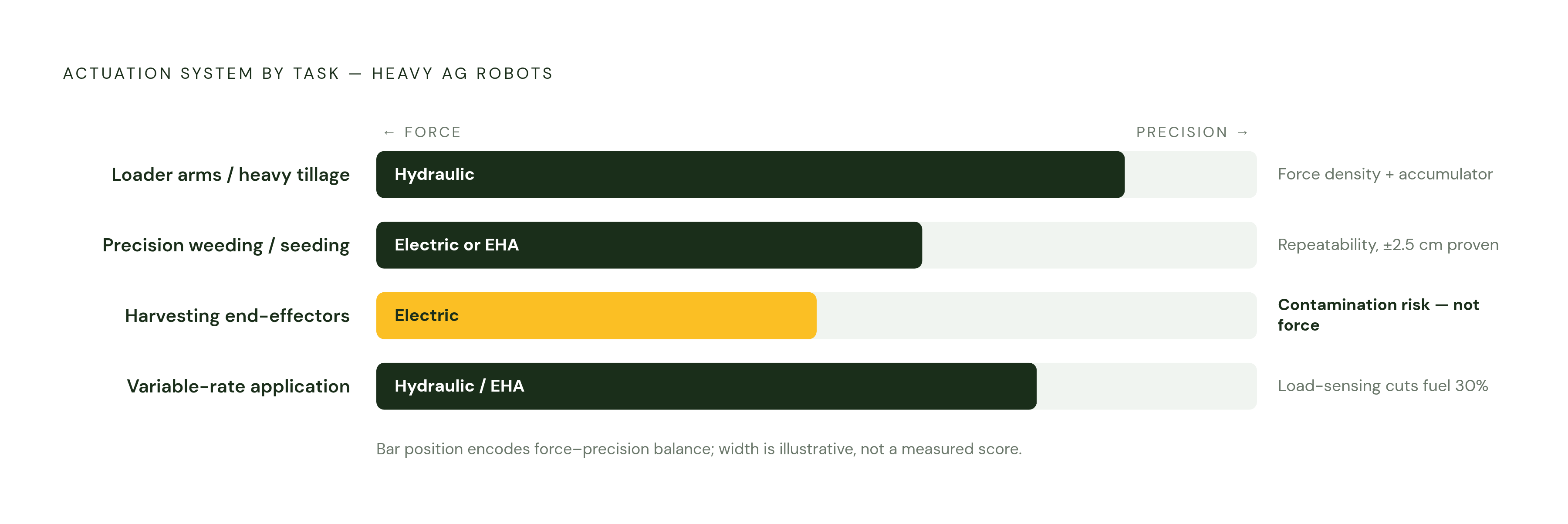
Run each task on a heavy ag robot through the same four questions: how much force density does it need, how much precision, how serviceable does it have to be out in a field, and how sensitive is it to energy efficiency losses. The answers split cleanly by task category, and the split tracks the underlying physics rather than any brand preference.
Loader arms and heavy tillage implements sit firmly on the force-density end of the spectrum, and their intermittent motion profile plays directly to the hydraulic accumulator's strength.
Precision weeding and seeding down-force control flip the priority. Precision and repeatability dominate over raw force, and electric or EHA options with integrated position feedback are the better fit, especially given that ±2.5 cm accuracy or better is already proven through electro-hydraulic steering in RTK-GNSS systems. Harvesting end-effectors that work close to the crop face a hard constraint that has nothing to do with force at all: fluid contamination risk simply isn't acceptable near food product, so electric actuation is strongly favored there, and current electric force ceilings are more than sufficient for that kind of work.
Variable-rate application implements deal with a highly variable demand profile, a scenario well-suited to load-sensing hydraulics or EHAs with ISOBUS integration. Up to 30% fuel savings from load-sensing pumps over old fixed-displacement systems isn't a rounding error, either. Across a full season of boom sprayer and loader cycles, that adds up to a material cost difference, not a marginal one. Hydraulic or EHA is favored, as full electric is not yet practical at heavy implement scale.
Sources
- All-Electric Heavy-Duty Robotic Manipulator: Actuator Configuration Optimization and Sensorless Control
- Robotics Actuator & Gripper Shifts by 2026
- Autonomous Robots and Precision Agriculture: Evolution, State of the Art, and Perspectives Towards Automated and Sustainable Agriculture
- Goodbye hydraulics! – tomorrow
- Agricultural Hydraulics 2026: Precision Farming Drives Smart Hydraulic Innovation | HCIC
- Agritechnica 2025: New Hydraulic and Electrification Technology Launches | Power & Motion Tech
- Surrogate-Enhanced Modeling and Adaptive Modular Control of All-Electric Heavy-Duty Robotic Manipulators