Teleoperation Latency Requirements for Field Robot Remote Operation
Safe remote operation depends on measured round-trip time, not video delay.
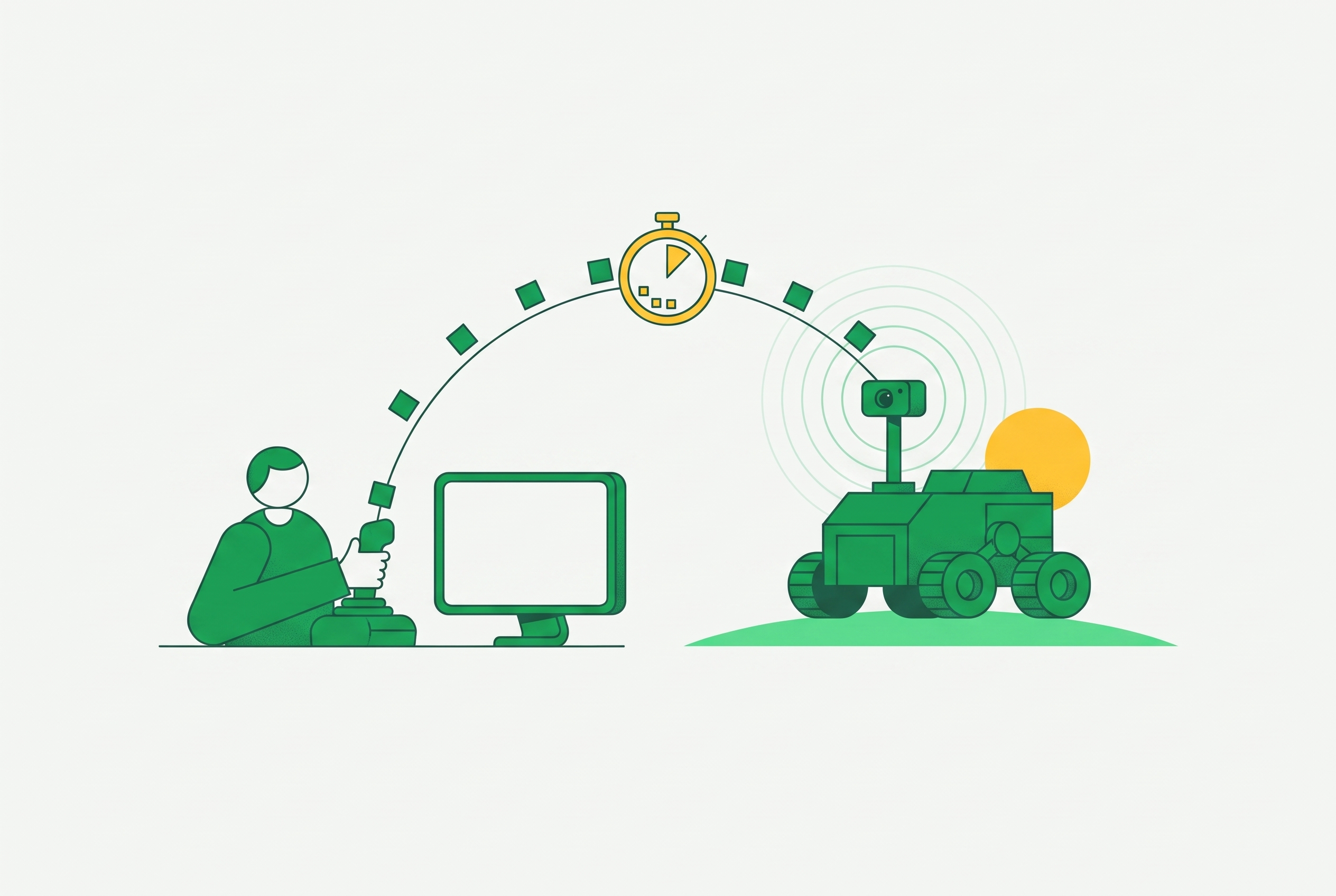
Field robot teleoperation depends on keeping the whole operator–network–robot loop under control even when there is delay. Its latency requirements therefore come from two interlocking constraints, network physics and human neurocognition. A workable specification must link the task’s failure threshold to end-to-end round-trip time measured in the field, since a low video-delay figure alone cannot prove that operation is safe.
Why end-to-end latency is the governing constraint in field teleoperation
An operator steering through unstructured terrain or correcting a robot arm needs feedback soon enough to guide the next action. If that feedback arrives too late, the closed loop cannot sustain stable control. The operator perceives delayed feedback, forms a corrective intent, sends a command, and waits for the result. Delay anywhere in that cycle compounds the difficulty of making the next correction.
The relevant measurement is the complete round-trip time, or RTT, from operator input through the network to robot action and back as sensory feedback. One-way video delay measures only part of that journey. A responsive video feed cannot establish that commands reach the robot promptly or that its actuators follow them without significant delay. If the channel degrades during a safety-critical action, an operator policy cannot repair the outcome.
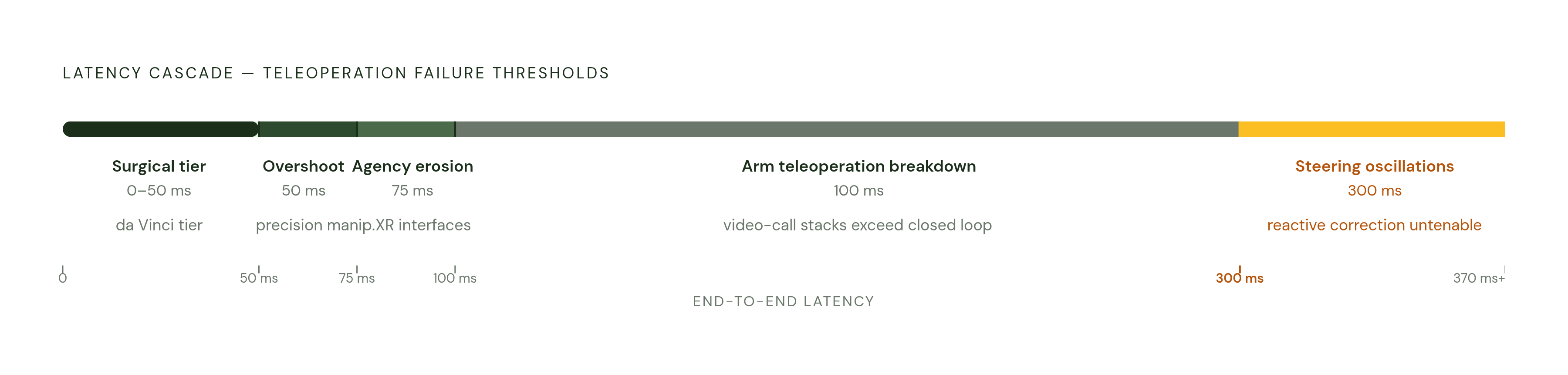
Network physics and human neurocognition impose separate constraints on this loop. Propagation, encoding, and protocol overhead consume time, while the operator’s motor-control system has limited tolerance for delayed feedback. Research shows that delay above 50 milliseconds can significantly increase overshoot and oscillations in closed-loop control. The human constraint therefore applies even when the communications system appears technically capable.
Where latency actually accumulates across the teleoperation stack
Every hardware and software layer contributes to the budget. The Motion-to-Motion Latency Measurement Framework for Connected and Autonomous Vehicle Teleoperation formalizes its measured total as command-generation delay, network communication latency, command-execution delay, mechanical actuator-follow delay, and measurement error. This separates transport from the work performed at either end. Video encoding consumes time before network transit, while robot-side computation, including Cartesian inverse kinematics with collision checking, adds further delay.
Glass-to-glass latency, or G2G, measures the time from camera capture to the operator’s display. It leaves actuation outside the measurement entirely. The framework defines Motion-to-Motion latency, or M2M, as the interval between the operator’s physical steering movement and the corresponding steering motion in the vehicle. Its field results found actuator-dominated M2M latency with medians above 750 ms in tested vehicles. A G2G-only specification would not expose that delay.
G2G characterizes the visual feedback path, while M2M reveals how quickly physical input becomes vehicle movement. Neither alone establishes the full closed-loop RTT. Each layer must therefore have its own delay measurement and budget, and the whole system must be tested under the conditions where it will be used. A lab-bench video result describes that test arrangement alone, leaving the end-to-end response of a robot operating over a shared field network unmeasured.
What the neurocognitive research establishes about human control under delay
The human control system expects feedback with little delay. Its strategy begins to degrade measurably before the operator necessarily notices lag. An interface can feel acceptable while the corrections made through it have already become less accurate. The engineering threshold must account for that degradation.
A 2024 fNIRS neuroimaging study of simulated remote manipulation found that neural activity patterns mirrored task performance across three conditions. These were no latency, combined visual and haptic delay, and visual delay alone. Performance was worst when both feedback channels were delayed. The result gives the behavioral effect a measurable neurological signature. Related research found that immediate haptic feedback can partially offset visual delay, showing that feedback channels have different cognitive roles.
XR-mediated teleoperation makes the progressive nature of degradation particularly clear. Above 75 ms, latency affects perceived motor performance and simultaneity. At higher delays, sense of agency and body ownership also erode.
The layered latency thresholds where specific failure modes appear
The first demanding tier is precision manipulation. Above 50 ms of G2G latency, overshoot and oscillations can become significantly more frequent, making this boundary relevant to surgery and fine assembly. The da Vinci Surgical System is the deployed platform described here that is most sensitive to latency. Surgery establishes the demanding end of the precision range. Because this threshold is expressed in G2G terms, however, it cannot stand in for a complete end-to-end RTT requirement.
General manipulation introduces a broader closed-loop breakdown boundary. Beyond it, delayed corrections no longer support the control needed for arm teleoperation, and conventional video-call stacks commonly operate above that boundary. Perceptual failures form another layer of the cascade. Noticeable lag and motion sickness can limit what the operator can do before reactive control fails altogether, especially when the task relies on an immersive interface.
For ground vehicles, the 300 ms steering-oscillation threshold identifies a distinct control problem. At still more severe delay, rapid reactive correction becomes untenable. The sequence therefore progresses from degraded precision and perception toward unstable movement and loss of viable reactive control. These are task-dependent failure modes, and every numerical threshold must retain the measurement definition attached to it.
How domain and task type shift which threshold is the operative constraint
The fastest required control action sets the operative constraint. Surgical teleoperation occupies the most demanding precision tier, with a sub-5 ms requirement. Robot arms and fine assembly instead depend on the closed-loop manipulation boundary appropriate to their tasks. A specification derived from a slower activity cannot establish suitability for those faster corrections. The task, rather than the broad category of teleoperation, determines which threshold governs.
Ground vehicles in unstructured terrain face the 300 ms steering-oscillation constraint, but reaction time is only part of the problem. The operator also acts on a delayed, incomplete view of terrain that differs from the robot’s onboard sensory reality. Increasing latency widens that perceptual mismatch. Agricultural robots face a related difficulty when delayed and inconsistent outdoor video misrepresents the robot’s actual viewpoint. Research has found that public 4G cannot support high-throughput, low-latency agricultural teleoperation.
A published deployment of a 5G-connected aerial robot in industrial subterranean mines measured uplink and downlink delays within its real-time remote-control budget. The large uplink capacity of 5G supports the high-definition video needed there. Remote inspection in nuclear facilities, disaster zones, and deep sea environments can tolerate higher latency and lower data quality than manipulation or driving. These tasks rarely need closed-loop correction as fast as manipulation or driving does.
Why field network conditions routinely push deployments past their latency budgets
Field acceptance depends on the 95th-percentile RTT under actual congestion, jitter, and network variance, compared with the median under ideal conditions. The gap can be substantial. A lab G2G result can more than triple at a customer site using a private 5G slice with shared backhaul. That change can move a system from below the manipulation boundary to above it. A controlled demonstration therefore does not establish that the same stack will remain viable on site.
When a fleet operates over a shared network, congestion is normal. When several robots use the same segment, commands get through promptly or wait behind video frames depending on congestion control. Conventional video-call infrastructure tends to back off the entire stream when packets drop. That behavior conflicts with manipulation’s need to preserve command delivery. Separate control and video streams allow visual quality to degrade without imposing the same loss of responsiveness on commands.
Network generation alone does not resolve this problem. Under load, 4G/LTE end-to-end latency sits above the manipulation boundary, while 5G standalone with network slicing can provide lower latency and dedicated performance independent of consumer traffic. That capability depends on actual 5G SA deployment. The operator facility also needs a defined minimum bandwidth floor, and home offices are incompatible with the safety-critical uses and enterprise security clauses described here.
Three mitigation strategies operators use to extend viable control beyond raw latency limits
Predictive displays target the perceptual gap between current robot motion and delayed video. They overlay estimated future robot states without reducing actual latency. Research on predictive video transformation interfaces found suppressed oscillatory control and improved task completion under high delay. Chakraborty et al.’s 2025 ICRA paper brought the approach to outdoor mobile platforms, using future-frame synthesis based on past images and robot pose. Prediction still needs a motion model that fits the task. Poor models and unpredictable surroundings weaken it precisely where unstructured terrain makes control difficult.
With shared autonomy, the human is outside the fastest reactive loops. The robot handles functions such as obstacle avoidance and stabilization while the operator sets goals. An instruction such as “change lane” replaces continuous micro-steering and reduces the frequency of the human closed-loop cycle while network speed remains unchanged. It is useful where intent-level interaction can replace delayed moment-to-moment correction.
Sousa Silva et al.’s 2025 ICRA paper from MIRRORLab found that lower performed autonomy increases cognitive load, especially when robot communication is frequent and latency is present. High latency also led to negative perceptions, whatever autonomy strategy was used. For ground vehicles, an autonomous traversability judgment can conflict with the operator’s intent.
Multipath network bonding and edge computing work to cut the delays in transport and processing. Combining 5G, LTE, and Wi-Fi paths can reduce baseline latency and the variance that pushes tail measurements beyond task thresholds. Multi-access Edge Computing integrated with 5G has achieved end-to-end latency within the manipulation boundary for agricultural platforms. Graceful degradation remains part of this approach. Path switching and lower video resolution preserve usable command delivery where a single-link arrangement would fail.
What requirements operators must actually design around when specifying a teleoperation system
The practical requirement is to translate these constraints into measurable commitments. Operators should start with the fastest reactive loop the task demands and map it to the relevant failure mode. Its threshold should become the upper limit for 95th-percentile end-to-end RTT, with the original threshold’s measurement definition kept explicit. A G2G research threshold cannot silently become an equivalent RTT figure. The resulting specification must account for the command, actuation, and feedback paths needed to complete the task.
Operators should require M2M measurements as well as G2G results and validate full RTT at the types of sites the fleet will use. Tests should include the congestion expected from robots at the same site and shared backhaul. The tail of the measured distribution is the acceptance target. Control and video separation should also be a structural transport requirement, so congestion reduces visual fidelity before it compromises command delivery.
Where the network cannot reliably meet the task’s threshold, the specification should name the appropriate mitigation. Predictive displays suit settings where robot dynamics are predictable, while shared autonomy suits tasks that allow intent-level control. Multipath bonding addresses heterogeneous network coverage. The specification must still account for the limits of each choice and keep the latency budget in force.
The remaining gap is partly one of measurement discipline. Of the published XR-enabled remote human–robot interaction studies examined in 2025, 49% left out latency effects even though their importance was known. That omission separates known control constraints from the evidence used to judge systems.
Sources
- Tele-Traversability: Rethinking Traversability for Teleoperated Ground Robots in Terrain Navigation
Supplied the ground-vehicle steering-oscillation threshold and the traversability issues in terrain teleoperation.
- Motion-to-Motion Latency Measurement Framework for Connected and Autonomous Vehicle Teleoperation
Provided the M2M versus G2G latency definitions, the latency component breakdown, and field measurements of actuator-dominated delay.
- Robotic teleoperation in hazardous environments: a review of feedback architectures, stability, and learning-based adaptation
Informed the discussion of feedback channels, stability under delay, and the sensitivity of different hazardous-environment tasks.
- The Effects of Communication Delay on Human Performance and Neurocognitive Responses in Mobile Robot Teleoperation - Beijing Institute of Technology
Supported the section on how communication delay affects operator performance and neural activity in mobile robot teleoperation.