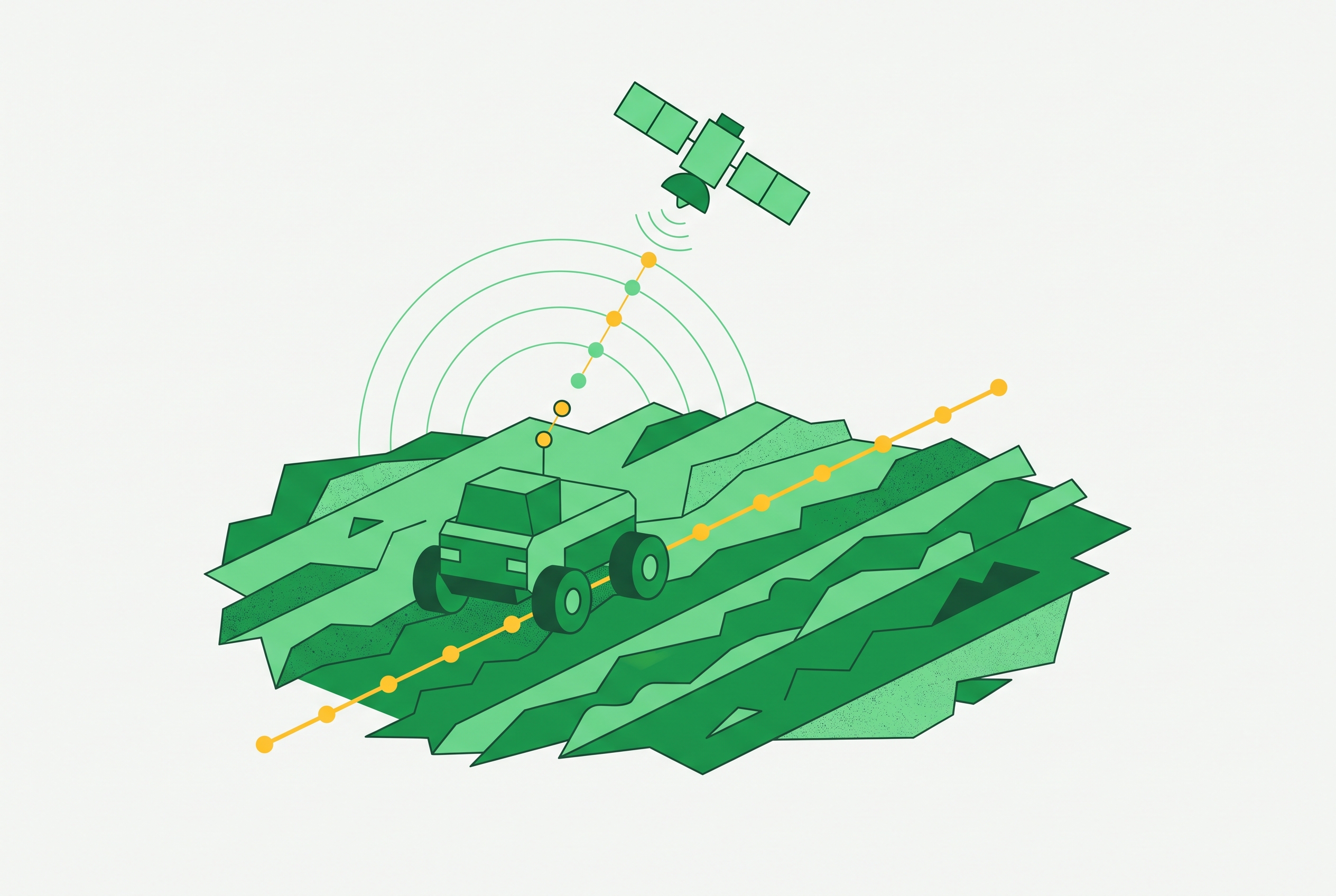
Multi-Robot Fleet Coordination for Large-Scale Crop Spraying
Sensing, variable-rate actuation, and path planning make fleets work.
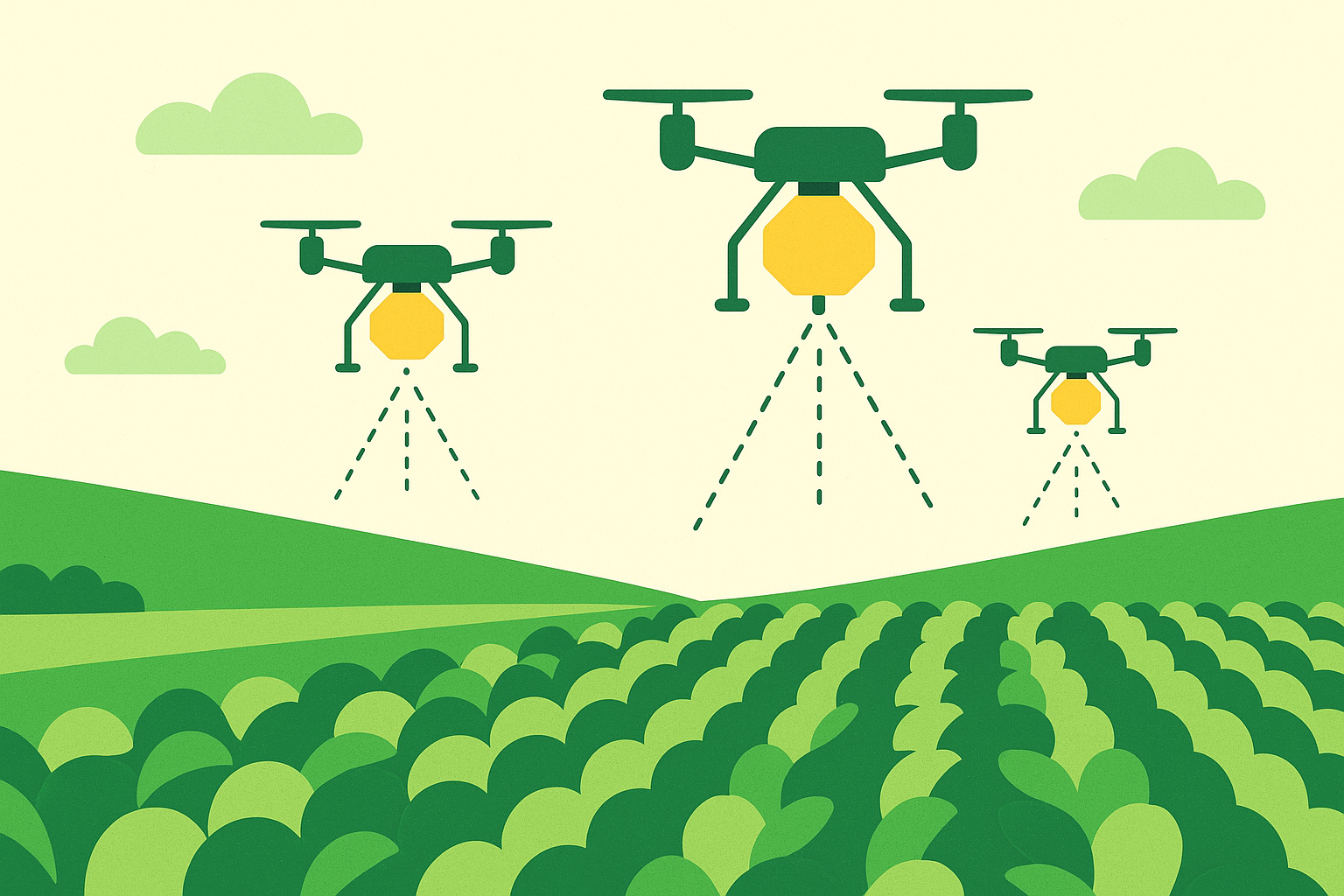
Crop spraying is changing quickly as farms grow larger, labor becomes harder to find, and herbicide-resistant weeds demand more precise, better-timed treatment. Autonomous spray robots and drones have shown clear gains over conventional equipment, but a single machine cannot cover broadacre fields within the narrow windows that agronomy allows. This post looks at how fleets of coordinated robots address that gap. It covers why single units fall short, the three technical layers that make a fleet work (sensing, variable-rate actuation, and path planning), and the trade-offs in coordinating them.
Why individual spray robots fall short at broadacre scale
Individual spray robots have demonstrated precision gains over conventional equipment. However, the scale demands of broadacre farming make single-robot deployment structurally insufficient. These demands are driven by labor shortages, herbicide resistance, and field sizes that dwarf what a single unit can cover in an agronomically useful window. The case for coordination is not simply "more robots cover more ground." Sequential single-robot passes create timing gaps that reduce treatment efficacy, whereas synchronized fleets compress the application window across the whole field.
A 2025 review in Computers and Electronics in Agriculture frames multi-robot agricultural systems as collections of coordinated units that enhance each other's capabilities. This distinguishes a fleet from a parallel deployment of independent machines. The shift from experimental to capital-expenditure thinking is already underway among large-scale operators and contract sprayers. Smallholders, by contrast, face persistent capital barriers that keep fleet technology out of reach for much of global agriculture.
How fleet coordination actually works: three interdependent technical layers
A functional multi-robot spraying fleet is not achieved by networking individual capable robots. It requires three distinct technical layers: sensing and crop diagnosis, variable-rate spray actuation, and autonomous flight path optimization and multi-UAV coordination. Each of these layers shapes and constrains the others. The three-layer framing comes from the precision spraying patent and research literature. The 2026 PatSnap Eureka analysis of agricultural drone precision spraying organizes the field's core technical domains along exactly these axes.
The layers are interdependent rather than sequential. The path planner needs the spray model's output to set coverage priorities, and the spray actuator needs the sensing layer's crop map to vary rates. The sensing layer, in turn, needs the planner's routing decisions to know where to look next.
Ground-based and airborne platforms interact differently within this architecture. UAVs provide wide-area sensing and communication relay, while unmanned ground vehicles execute high-precision interventions. Even so, the three-layer logic applies to both and to hybrid fleets combining them. The sections below take the layers in order, starting with sensing.
Sensing and crop diagnosis as the fleet's shared information foundation
Fleet coordination at scale is only as good as the shared picture of the field that all robots act on. Sensing and crop diagnosis are not a pre-mission step but a continuous, fleet-wide information layer that every subsequent decision draws from.
AI-driven recognition, specifically YOLO-based neural networks, has become the dominant approach for real-time identification of spray targets in the field. The 2026 PatSnap Eureka precision spraying analysis documents CNNs and YOLO-based architectures as one of four patent and literature clusters in the precision spraying landscape. It identifies drone-guided real-time boom sprayer feedback as the dominant patent cluster.
A published UAV swarm system for organic orchards demonstrates the practical reach of this approach. Equipped with YOLOv10 neural networks, the swarm detects and geo-locates invasive weeds, achieving strong F1-scores for both Araujia sericifera and Cortaderia selloana. It also produces the geo-referenced weed maps that the actuation layer needs to assign variable rates. Source: ScienceDirect, 2024.
Sensing data becomes genuinely useful at fleet level only when it feeds a shared semantic map. The end–edge–cloud framework from Shanghai Jiao Tong University (September 2026) assigns semantic event interpretation to an edge-hosted vision-language planner that receives event-triggered state feedback from robots. Meanwhile, the cloud maintains the fleet's shared farm topology and dispatch policies. What matters about sensing is the function it performs, which is shared situational awareness across the fleet.
Variable-rate spray actuation: translating crop diagnosis into precise chemical delivery
Knowing where problems are in a field is only useful if the spray system can respond with the right rate at the right location. Variable-rate actuation is the layer where sensing intelligence is converted into differentiated chemical application, and it is where the fleet earns its environmental and economic justification.
Chemical management flexibility matters for precision. The Prospr attachment offers options for direct tank mixing or inline dosing for more precise concentration control. This distinction affects how tightly the fleet can target specific zones within a field.
At the aerial end, capacity and flow rate are the actuation parameters that define what a fleet unit can contribute per sortie. The following six units illustrate the range of actuation capability across a commercial fleet. A high-capacity unit suits different assignments than a precision low-volume unit, which is what makes task allocation across a mixed fleet meaningful.
The HYL-150 ARES (Hylio) has a 40-foot spray swath and a 110-pound liquid capacity, and it covers up to 70 acres per hour. It is swarm-enabled via AgroSol Ground Control Software for multi-drone coordination across thousands of acres. (CropLife, 2026.)
The HD580 (Raptor Dynamic) carries an 18.5-gallon tank and delivers up to 10.5 gallons per minute through four centrifugal nozzles. Its maximum speed is 30.8 MPH. (CropLife, 2026.)
The XAG P150 (Pegasus Robotics) has an 18.5-gallon liquid tank and delivers up to 7.9 gallons per minute. It uses a quad-rotor downdraft for uniform coverage and four centrifugal nozzles, and it flies autonomously at up to 40 mph. (CropLife, 2026.)
The DJI AGRAS T50 (Ag Technology Solutions) uses coaxial twin-rotor propulsion and carries an 88-pound spraying payload or a 110-pound spreading payload. Its magnetic drive impeller pump delivers up to 6.34 GPM through four nozzles. (CropLife, 2026.)
The J100 (Agri Spray Drones / EAVision) has an 11.9-gallon spray tank, plus an optional 110-pound spreader. It covers up to 60 acres per hour at 2 GPA and uses LiDAR terrain following. (CropLife, 2026.)
The AYRE CX (Exedy Drones) has a 15-gallon product tank, a centrifugal rotary atomizer, and an electrostatic pump. It carries a 125-pound liquid payload or a 154-pound dry payload, has a maximum operating speed of 31 MPH, and runs on a 34 Ah battery. It is designed for row crops, terraced hills, and edge-of-field spots. (CropLife, 2026.)
The environmental argument for variable-rate actuation over uniform blanket application is not marginal. Research on swarm robotics in agriculture establishes that reducing over-application cuts chemical load and water use, which lowers environmental pollution. This benefit only materializes if the actuation layer is actually responsive to the sensing layer's prescription, rather than just spraying a uniform rate at high throughput.
Path planning and inter-robot coordination: the layer that makes a fleet act as one
Effective path planning for a spray fleet must simultaneously solve coverage completeness, workload balance among robots, and collision-free inter-robot coordination. The methods used to solve these three sub-problems determine whether the fleet achieves its theoretical throughput or falls into scheduling deadlock and redundant coverage.
The fundamental tension is between centralized and decentralized control. Centralized control enables globally optimal task allocation, because the cloud can see all robots and all field zones simultaneously. However, it creates a single point of failure and requires reliable connectivity. Decentralized consensus algorithms, including average consensus, max-min consensus, and approaches using factor graphs and belief propagation, allow robots to reach agreement through local peer-to-peer communication. This provides resilience when connectivity is patchy, which is the realistic condition in large open fields. Source.
The end–edge–cloud framework from Shanghai Jiao Tong University resolves this tension through hierarchy. The cloud handles fleet-level dispatch policy, and the edge runs an asynchronous vision-language semantic planner and a fast trajectory planner. The robot handles sensing, LiDAR odometry, and low-level execution, which separates the slow global optimization from the fast local response. Source: Agronomy, September 2026. In a four-robot test topology, this framework achieved a perfect success rate under a representative single-blockage condition.
A second, underappreciated planning problem is kinematic realism. Research published in Robotica identifies that most multi-robot coverage path planning methods ignore the nonholonomic constraints of real robots during planning. As a result, the theoretical path cannot be executed as planned, producing task imbalance and prolonged coverage time. Game-theoretic approaches that model actual Dubins-vehicle kinematics address this by dynamically reallocating tasks based on true path costs.
The graph-based SprayCraft approach treats variable-rate prescription maps as a routing optimization problem. The SprayCraft framework builds a graph of field zones weighted by crop diagnosis output and optimizes spray routes to minimize chemical waste while maintaining coverage. In doing so, it connects the sensing and actuation layers directly into the path planner.
Ground-air hybrid fleets introduce sequential task dependencies that compound the scheduling problem. In multi-orchard scenarios, a ground robot must complete a ground-level operation before a UAV can begin spraying, and this sequencing constraint makes optimal scheduling significantly harder. 2025 research in Expert Systems with Applications is actively developing evolutionary algorithm-based task assignment mechanisms to handle these dependencies dynamically.
A validated field result anchors the discussion: coordinated
Sources
- Reconfigurable agricultural robotics: Control strategies, communication, and applications - ScienceDirect
Framed multi-robot agricultural systems as coordinated units that enhance each other's capabilities, distinguishing fleets from parallel deployments.
- SprayCraft: Graph-Based Route Optimization for Variable Rate Precision Spraying
Supplied the graph-based approach that treats variable-rate prescription maps as a spray routing optimization problem.
- End–Edge–Cloud Collaborative Fast–Slow Semantic Planning for Agricultural Field Robots
Described the end–edge–cloud hierarchy for fleet dispatch, semantic planning, and fast trajectory control, including the four-robot test result.
- AI-based autonomous UAV swarm system for weed detection and treatment: Enhancing organic orange orchard efficiency with agriculture 5.0 - ScienceDirect
Provided the example of a UAV swarm using YOLOv10 to detect and geo-locate invasive weeds in organic orchards.
- Cohesion-Based Flocking Formation Using Potential Linked Nodes Model for Multi-Robot Agricultural Swarms
Supplied the discussion of decentralized consensus algorithms versus centralized control in multi-robot agricultural swarms.
- (PDF) Swarm Robotics and Multi-Agent Systems in Agriculture
Supported the point that reducing over-application cuts chemical load and water use, lowering environmental pollution.
- Game-based coverage path planning for multiple Dubins robots in agricultural fields
Explained how ignoring nonholonomic constraints undermines multi-robot coverage plans and how game-theoretic Dubins-vehicle methods reallocate tasks.