Selective Harvesting Robots for Strawberries and Soft Fruit
Four engineering problems make strawberry picking robots harder than they seem.
Selective harvesting of strawberries and soft fruit has outpaced automation efforts for a specific, identifiable reason: four distinct engineering problems (occlusion, ripeness variability, fruit fragility, and harvest speed) compound one another, so a fix for one tends to make another worse. This piece works through each challenge in turn, then looks at what current robots and research systems have managed to do about them, and what that record suggests about how close the industry actually is to replacing a human hand in the field.
Why soft fruit has resisted harvest automation
Labor economics give the problem urgency, but they don't explain the engineering difficulty, and the two should not be confused. Harvest labor has grown scarcer and more expensive across much of the strawberry-growing world, and because immigration enforcement has sharpened that scarcity beyond what growers saw in past decades, many operations are turning toward automation for the first time. Surveys of growers now rank harvest automation as their top technology investment priority, and most of what they plan to spend goes toward harvesting technology. But none of that pressure makes strawberries easier to pick by machine. The crop remains difficult because four separate problems, each hard on its own, interact badly: a robot built to see through leaves tends to move slowly; a robot built to move fast tends to bruise the fruit; a gripper built to handle one ripeness state often mishandles another. The rest of this piece treats the gap between grower demand and robot capability as a technical question, one you need to understand on its own terms instead of trusting a promise that robots are coming.
Occlusion defeats standard machine vision approaches
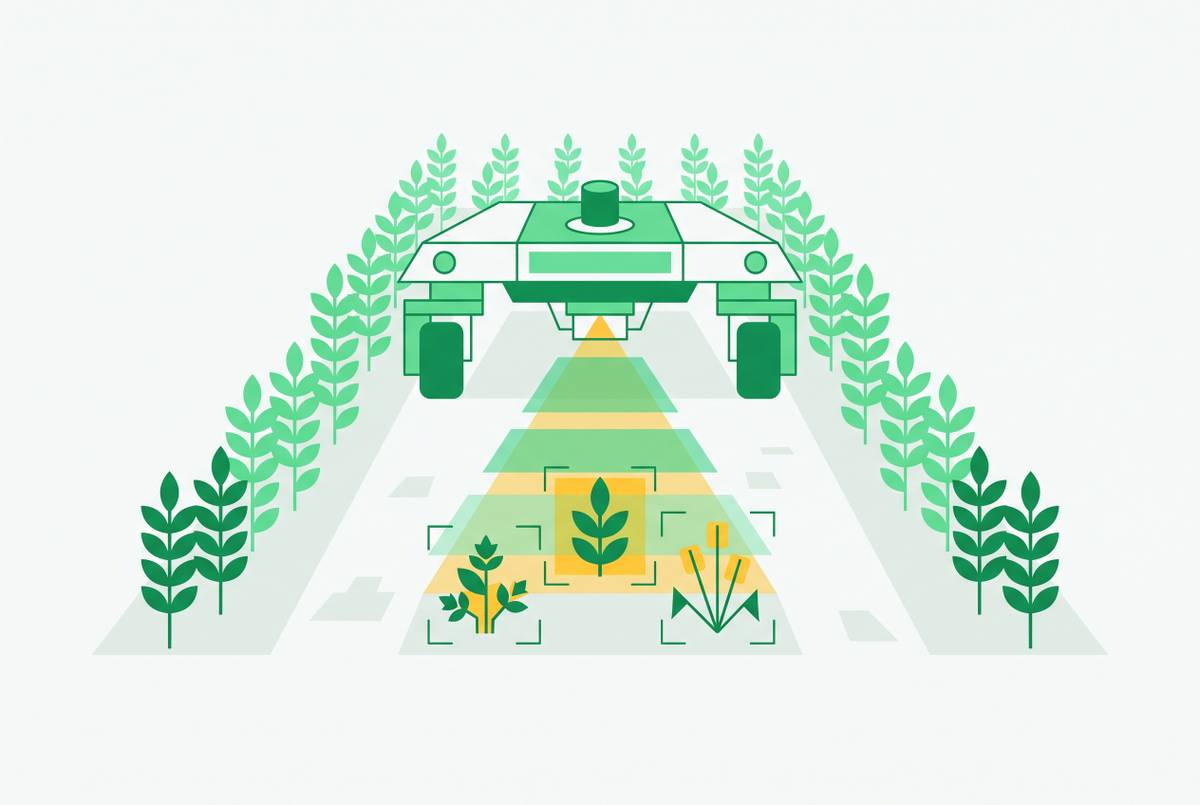
Every robotic harvester depends on a camera finding the fruit before any arm moves, and in open-field strawberry growing, that first step fails constantly. Ripe berries sit beneath the plant canopy much of the time, hidden from a camera mounted above or beside the row, and AgFunder News reports that in some locations up to 30% of the strawberry crop gets left to rot on the ground as a direct result. A standard setup, pairing a color camera with a depth sensor, can localize fruit once it has a line of sight, but a berry the camera never registers produces no detection signal. No signal means no pick attempt, regardless of how ripe that berry is or how close the gripper sits to it.
The failure rarely stays contained to the detection step. Once occlusion causes a missed or partial view of a berry, the errors that follow tend to pile up rather than cancel out: ripeness misclassification, drift in how the system tracks a berry's identity across frames, and depth or calibration errors all feed off an incomplete first look. Blueberries present a related but distinct version of the same problem. Instead of leaves hiding the fruit, dense clusters hide berries behind one another, so a berry that is visually clear but surrounded by contacting neighbors still defeats the localization strategies built for crops like strawberries, where fruit sits larger and more spread out. The CLASP research documents this cluster geometry as its own occlusion variant, distinct from canopy cover but governed by the same upstream logic: a robot cannot act on what it cannot first resolve into a discrete, locatable target.
The WSU fan-assisted harvester and occlusion
A Washington State University-led team took a mechanical route to a problem that most labs had treated as a pure vision challenge. Their harvester pairs an AI vision system with soft silicone fingers and a fan, and air blown through tubes near the gripper pushes leaves out of the way before each pick. The logic is straightforward: if the camera can't see through a leaf, move the leaf.
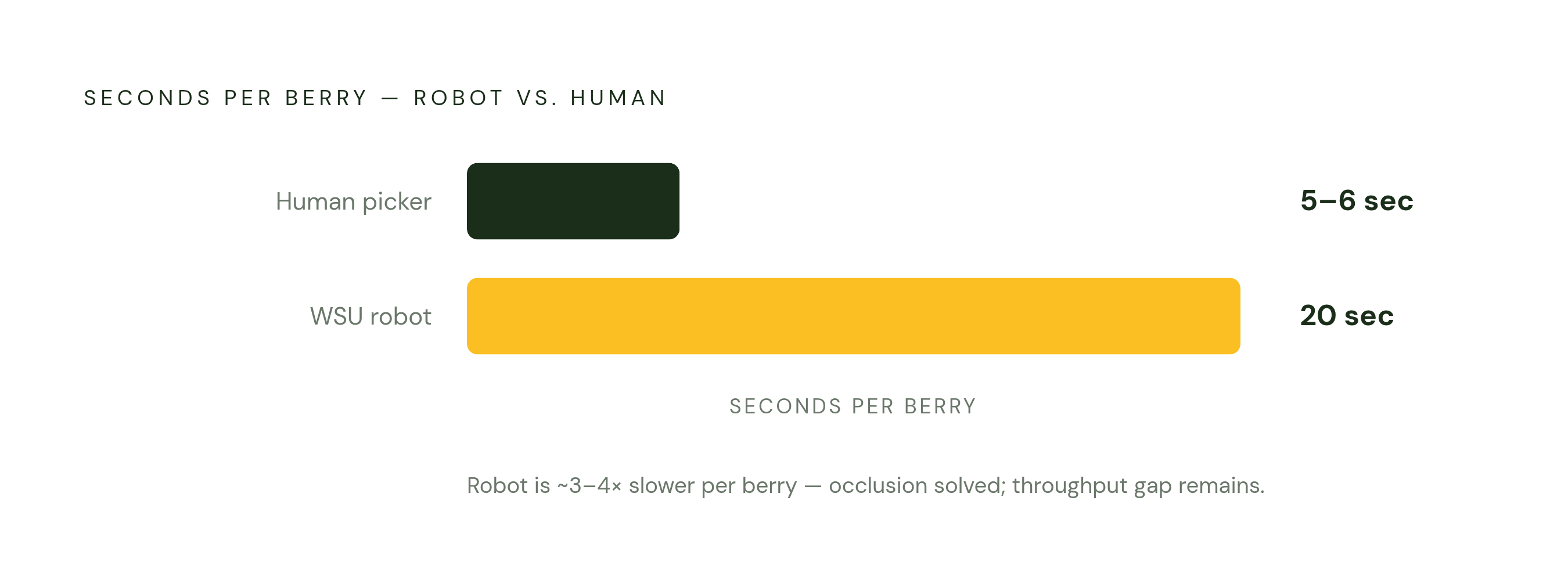
The approach worked, to a point. When the fans stayed off, the system picked most of the ripe fruit it attempted, but turning them on raised that picking rate substantially. Detection accuracy, measured across lab and outdoor field trials, topped out around 80%, meaning roughly four in five berries were correctly identified. The research team's own numbers also expose the system's real constraint: it averaged 20 seconds per berry, against a human picker's roughly five to six seconds. Clearing leaves out of the way solves a perception problem, but the throughput problem that follows immediately after stays untouched. That gap between what gets detected and how fast a robot can act on the detection is the exact seam where the next challenge begins.
Gripper design and the speed-bruising trade-off
Speed and gentleness pull against each other by basic physics. If you pick faster, you move the gripper with more force and more contact energy per unit time, and both raise the odds of bruising a berry whose skin tolerates very little pressure before it marks. Slowing the system down to protect the fruit cuts into the economic case for using a robot instead of a person. The trade-off itself, not either side of it alone, sets the ceiling on what a harvester can deliver commercially.
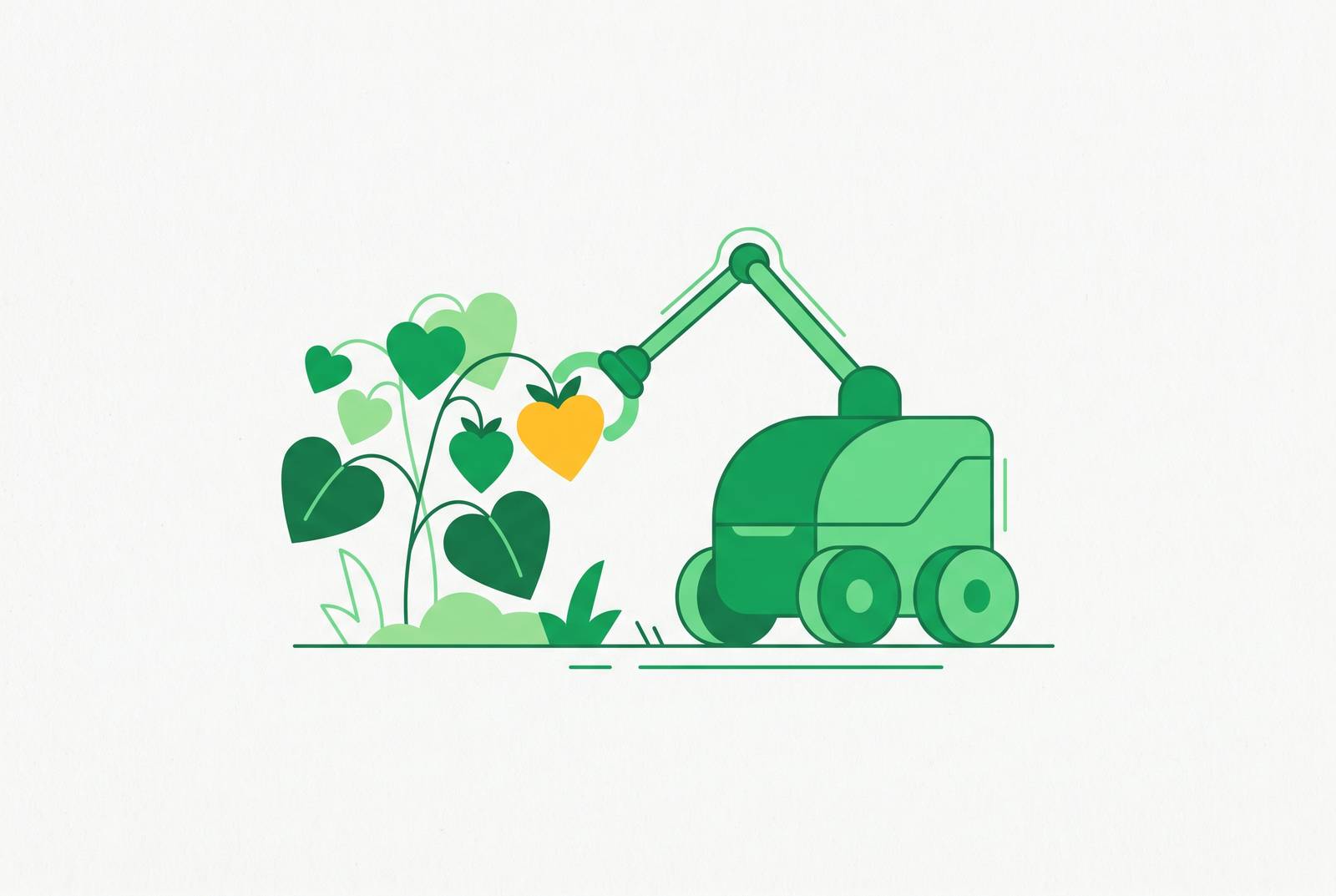
Soft gripper design is the main engineering answer to that trade-off, and researchers and companies have built three distinct architectures around it. The WSU harvester uses silicone fingers: compliant and cheap to produce, though their fixed geometry limits how well they adapt across a range of berry sizes. A second approach, developed at Texas A&M as the ANGEL gripper, uses 3D-printed TPU pockets drawn closed by steel cables, distributing pressure evenly around the fruit rather than concentrating it at a few contact points; motor feedback lets the gripper adjust its own grip autonomously, and testing on tomatoes recorded zero immediate damage with bruising below nine percent after five days. A third approach, built at Georgia Tech for the CLASP system, works at the cluster level rather than the single-berry level: a soft active rolling-band gripper, called the SARB-Gripper, uses two compliant bands that envelop an entire blueberry cluster and detach ripe berries through rolling contact, with closed-loop force control keeping the load under the threshold that would dislodge immature fruit, reproducing a commanded pulling force to within a few percent.
Among systems closer to commercial deployment, DailyRobotics' Q2 harvester uses a soft gripper built to hug the fruit rather than squeeze it, and AgFunder News reports field bruising rates around 4%, a figure that tracks closely with skilled hand-picking, so the industry uses it as the benchmark for judging whether a harvester is ready for commercial fields. The ANGEL and CLASP systems remain research prototypes, developed and validated in university labs, but DailyRobotics has moved further, toward paid deployment, and that distinction matters when you judge how close any of these approaches sit to a grower's field. Size and shape variation across individual berries adds a further constraint on top of speed and force: a gripper tuned to an average-sized berry will crush a small one and fail to secure a large one, so handling natural variation in fruit size is a basic design requirement rather than a later refinement.
Ripeness classification in the perception pipeline
Ripeness classification isn't a step a robot performs after locating a berry. It runs inside the same perception pipeline that drives localization, the arm's approach path, how hard the gripper closes, and which bin the berry ends up in, so an error here doesn't stay local. It propagates into every decision downstream of it.
The classification task itself carries real difficulty. Outdoor lighting shifts constantly and changes how a berry's color reads to a camera; if a berry is partly occluded, the one visible patch may not show its overall ripeness; and even the same strawberry cultivar can show different color signatures at identical ripeness, depending on the weather and growing conditions that week. DailyRobotics' Q2 handles this by imaging and evaluating each berry through a perception pipeline that classifies size, surface defects, color maturity, and over-ripeness, then routes the berry to the matching bin or clamshell, folding harvesting and the packing-house quality check into a single pass through the field.
The CLASP blueberry system classifies ripeness without judging color at all, instead reading a mechanical signature: field measurements show a clear separation in detachment force between mature and immature blueberries, and the gripper's closed-loop force control, which reproduces a commanded pulling force to within 3.7% according to the CLASP research, uses that force gap to pick ripe fruit without disturbing unripe neighbors. The broader pattern across these systems is that perception failures rarely stay isolated. A misclassified berry at the perception level can trigger a bad path plan or a collision-avoidance error at the motion level, which in turn produces a loose grasp, a failed detachment, bruised fruit, or a jammed gripper at the contact level. Each layer depends on the one beneath it being right, and that dependency is what makes the perception pipeline the most fragile link in the entire system.
The indoor-versus-outdoor divide and commercial viability
All four challenges, occlusion, ripeness variability, fragility, and speed, get easier to solve once the growing environment is built around the robot instead of asking the robot to adapt to whatever a field throws at it. Indoor and vertical-farm operators can fix the lighting, which removes color-signature variability; control row geometry, which reduces occlusion; set plant height, which simplifies the arm's approach trajectory; and schedule harvest timing, which concentrates ripeness into predictable windows instead of spreading it across a field unevenly. Oishii bought Tortuga AgTech's intellectual property, assets, and engineering team, and that is the clearest sign yet that companies growing the fruit choose to absorb robotics capability directly, rather than buy it as a service, so they close that feedback loop in-house.
Tortuga's robot won the 2024 Future Farming Ag Robot of the Year Award, and Oishii's COO said that by the end of 2025 the company expected its robots to run around the clock, outpacing human pickers, harvesting more of its premium Koyo strawberries than human pickers while cutting harvesting costs substantially. Open-field operators have no such advantage, so every challenge hits them at full strength at once. DailyRobotics built its Q2 harvester for field-grown strawberries at plant bed widths of 2.2 to 4.6 feet, and its dynamic perception system actively searches the canopy, driving the arm with a camera into the leaves to look for fruit, a step an indoor system wouldn't need. Harvest CROO Robotics announced in April 2025 that its field trials had shown commercial viability, reaching performance on par with human harvesting in a commercial picking operation, and it said vision processing was dramatically more capable than the year before, after it moved to a newer generation of NVIDIA chips. Tabletop growing systems are spreading for reasons that have nothing to do with robots, since they raise yields and labor efficiency on their own, and that spread is quietly making more of the industry's growing environment robot-friendly before any robot shows up to use it.
Commercially deployed systems in 2025 and 2026
The number of systems operating at real commercial scale remains small, and most of what exists today sits in field trials or early deployment rather than widespread use. The performance figures from these early deployments mark out the boundaries of what the current generation of hardware and software can do.
DailyRobotics, founded in Israel in 2022, plans to deploy its first robots with a California customer starting in April 2026. The Q2 harvester runs two robotic arms with soft grippers on battery power, built for field bed widths of 2.2 to 4.6 feet. Current field performance runs around 30 kg per hour, and the company says the hardware can reach 50 kg per hour once software optimization catches up to it. One operator can oversee as many as eight robots at once, and the machine packs strawberries directly into clamshells, fitting into a farm's existing workflow rather than requiring a new one. DailyRobotics claims its system picks 2 to 3 times faster than a human picker, and that figure matters because manual picking costs run so high in California specifically.
Europe led the strawberry picking robot market by global share in 2025, because Spanish and British producers face severe seasonal labor shortages. Investment activity in the sector, including a funding raise by Dogtooth, shows that investors see European commercial-scale deployment as something achievable, not just speculative. The figures across these systems don't all point the same direction: a robot running continuously at a modest hourly rate represents a different value proposition than one claiming to outpace a human picker outright, and both are legitimate paths to the same goal. Reading them side by side, rather than picking a single winner, is the more honest way to judge how far this technology has actually traveled.
Reliability and fault recovery over peak performance
The figures above describe best-case or average-case performance: kilograms per hour under good conditions, bruising rates under controlled field trials, detection accuracy measured across a known test set. None of them describe what happens when a gripper jams on a stem, when a depth sensor drifts out of calibration after a week of dust and vibration, or when a robot's path planner has to recover from a collision it didn't anticipate. Those are the failure modes documented at the motion and contact levels: incorrect path planning, collision avoidance errors, inverse kinematics failures, loose grasps, failed detachments, and jamming. A system that performs well on paper but stalls out every time one of these faults appears in the field isn't ready for a grower who needs a harvester running unattended for ten hours a day across an entire season.
That is the real measure separating a research prototype from a commercial product: not how fast it picks on its best run, but how it behaves on its worst one, and how quickly it recovers without a technician standing beside it. DailyRobotics has built its maintenance approach around that requirement directly, with a QR code on each unit opening a mobile interface that shows real-time diagnostics, subsystem health, error logs, and remote support tools, so a grower's own staff can troubleshoot a fault rather than wait for a specialist to arrive. Every challenge covered in this piece, occlusion, ripeness classification, bruising, and speed, eventually comes down to the same question: does the system keep working when something goes wrong in a field that was never built for it. That question, more than any single performance number, is what will determine which of these systems earns a permanent place in the industry's fields rather than a place in its research papers.
Sources
- CLASP: A Cluster-Level Autonomous Selective Picking Robot with a Soft Rolling-Band Gripper for Fresh-Market Blueberry Harvesting
- DailyRobotics enters strawberry harvesting race with robot that can pick 2–3x faster than humans
- Robotic harvester uses AI vision and soft grippers to pick hidden strawberries
- ANGEL: A Novel Gripper for Versatile and Light-touch Fruit Harvesting
- Researchers design robot that can pick hidden strawberries