Fixed-Wing Drone Endurance Records and Propulsion Benchmarks
Propulsion class, not airframe design, sets the endurance ceiling for fixed-wing drones.

Fixed-wing drone endurance comes down to a single constraint: how much energy a platform can store or harvest for every kilogram it carries. Three propulsion classes, battery-electric, hydrogen fuel cell, and solar-augmented, each set a different ceiling on that number, and every endurance record worth tracking traces back to which class a given platform belongs to.
Propulsion Class and the Endurance Ceiling for Fixed-Wing Drones
Airframe design matters. A glider-like fuselage with low wing loading stretches whatever energy a drone carries, and engineers have gotten very good at squeezing extra minutes out of a fixed energy budget through better shaping, lighter structures, and smarter aerodynamics. None of that changes which propulsion class a platform belongs to, and the propulsion class is what decides the outer limit. A beautifully optimized battery-electric airframe will not out-fly a modest hydrogen platform, and a modest hydrogen platform will not out-fly a modest solar platform running at full harvest. The energy-density hierarchy runs from lithium-polymer batteries at the bottom, up through compressed-hydrogen fuel cells, further up through liquid-hydrogen systems, with solar augmentation sitting on a separate axis because it partially decouples endurance from how much energy the aircraft can carry. That hierarchy is why the benchmark numbers cluster where they do. Battery-electric commercial platforms top out after a few hours. Hydrogen platforms push well past that mark. Solar-electric platforms have already flown for days at a time, not just hours. None of this is coincidence, and none of it is something a better wing can undo.
What battery-electric fixed-wing platforms can and cannot do
Battery-electric fixed-wing drones have hit a practical ceiling: a few hours, and no more. For a lot of mapping and survey work, that ceiling is plenty. For persistent ISR, long-corridor inspection, or any BVLOS mission that needs hours of loiter time over a target, it falls short in a way no amount of battery tuning fixes.
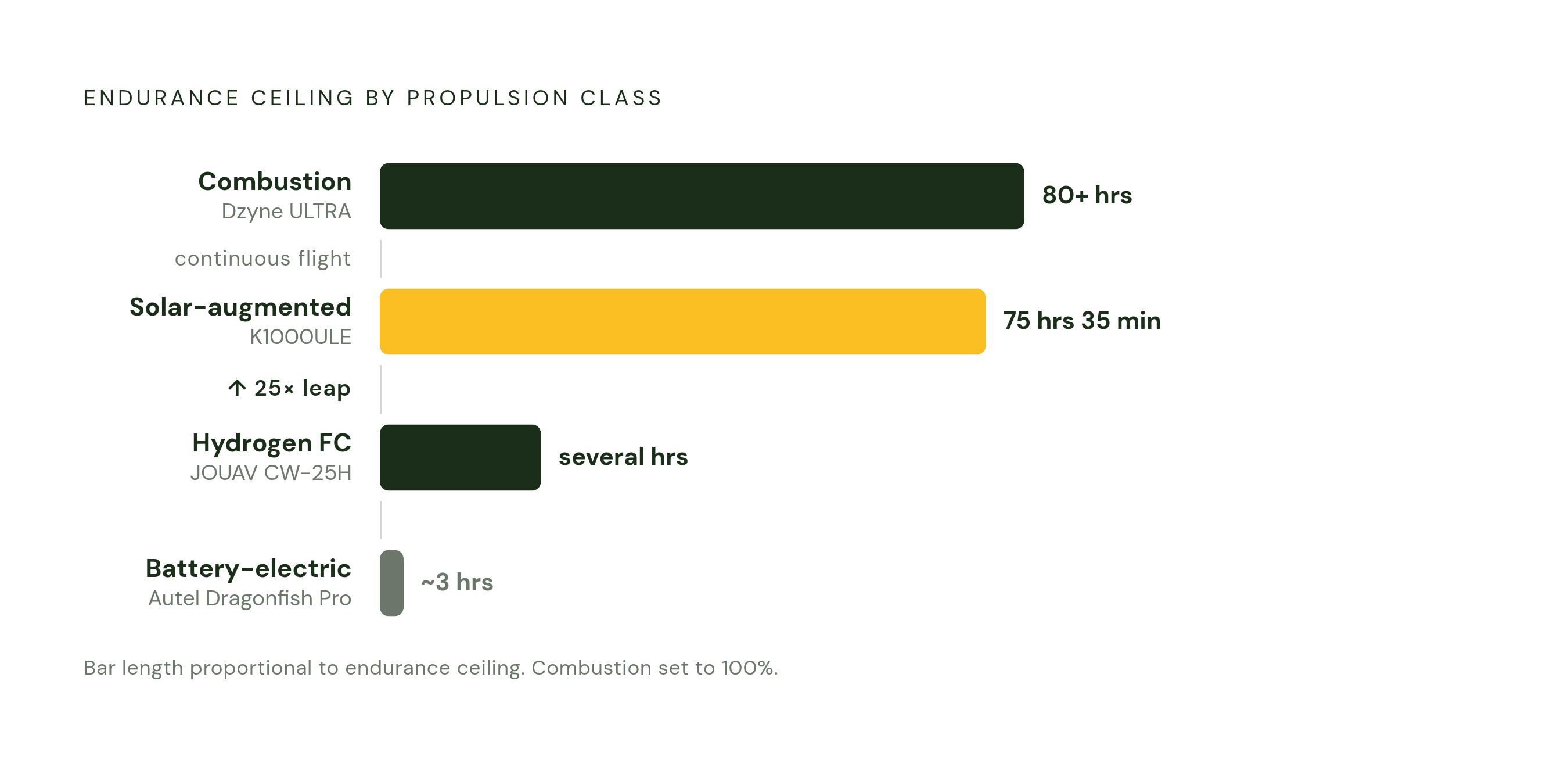
The commercial lineup makes the ceiling concrete. The Trinity F90+ flies for 90 minutes with a 15 km range and carries dual RGB and multispectral payloads, and it's positioned as the endurance leader in the professional mapping tier. The Wingtra One Gen II flies under an hour with a 10 km range, it carries certification for government procurement use, and it trades endurance for positional accuracy in the precision-mapping segment. The Autel Dragonfish Pro reaches 158 minutes of flight time with a 15 km range and VTOL capability, and that puts it near the top of battery-electric endurance among hybrid VTOL designs. The JOUAV CW-30E goes further still: a hybrid gasoline-and-battery fixed-wing VTOL platform with a 200 km control range, often described as the peak of electric drone endurance reached in 2026. That these numbers sit where they do isn't an accident of engineering effort. Lithium-ion batteries work best for missions under roughly 42 minutes on fixed-wing VTOL UAVs, and past that crossover point, fuel cells start to hold a structural advantage. The commercial ceiling comes from extraordinary optimization squeezed into a fixed energy budget, and no next design cycle is waiting to break through it.
There's a fair counter-argument here. Battery energy density keeps improving year over year, and for mapping missions of moderate length over open, predictable terrain, the battery-electric ceiling already covers the job. Switching propulsion classes isn't something every operator needs to do. But sufficiency for standard survey missions doesn't touch the mission classes driving military and BVLOS commercial investment, persistent surveillance, wide-area search, long-corridor inspection, where the gap between battery-electric and hydrogen or solar isn't a matter of degree. It's categorical.
JOUAV's own product line shows this most clearly. The CW-25E and the CW-25H share the same airframe family, so the only thing that changes between them is the propulsion system, and that swap alone adds substantially to endurance. Keep the same wings, the same fuselage, the same control systems, and change only how the aircraft gets its energy, and the endurance ceiling moves. That's the propulsion-class gap in its purest form, and it's the reason the next class deserves a closer look.
How hydrogen fuel cells break through the battery-electric ceiling
Hydrogen fuel cells extend fixed-wing endurance by a margin no battery optimization can close, and the technology has moved from demonstrator to field-proven. Early in 2026, a hydrogen-propelled fixed-wing UAV saw combat for the first time.
The endurance numbers build a clear ladder. The JOUAV CW-25H delivers several hours of endurance, it won a CES 2022 Innovation Award, and it was the first practical hydrogen-powered VTOL fixed-wing UAV to reach the market. The H3Dynamics HYWINGS fixed-wing platform extends multi-hour endurance further up the ladder. The Skyeton Raybird, in its hydrogen-hybrid configuration, is projected to reach many hours of flight time.
The Raybird case carries the most weight in this comparison, because it exists in two versions built on the same airframe. The ICE (combustion) version flies for more than a day and covers a range spanning thousands of kilometres at high altitude. The hydrogen-electric hybrid version, as of January 2026, reaches roughly half the ICE version's endurance, and engineers are working to close that gap further. What turned hydrogen from a benchmark curiosity into a battlefield technology was the combat deployment confirmed in early 2026, the first time a hydrogen-propelled fixed-wing UAV saw operational use in live conflict. That single event moves hydrogen propulsion out of the test range and into the category of proven military hardware.
Hydrogen's advantages go beyond raw flight time. Fuel cells run quieter than combustion engines and produce a thermal signature close to zero by comparison, both of which matter directly for ISR missions where staying undetected is the whole point of the mission. Maintenance costs run lower than combustion alternatives, and refueling takes a fraction of the time that recharging a battery pack does, which matters enormously for any operation that needs to turn an aircraft around fast.
None of this comes free. Hydrogen fuel cells run at substantially lower efficiency than lithium batteries, an intrinsic electrochemical disadvantage that hydrogen has to make up for with superior energy density. That tradeoff makes hydrogen the right bet on long missions and a weaker case on short ones, where the efficiency penalty outweighs the density advantage before the aircraft ever gets the chance to use it. Compressed-hydrogen storage is operationally simpler to handle on the ground, but liquid-hydrogen systems carry substantially higher energy density. Liquid-hydrogen ground tests have shown that you can deliver very large quantities of electrical energy, enough to support ranges of thousands of kilometres on a mid-sized fixed-wing airframe. Cryogenic storage brings a boil-off problem that compressed gas never has to deal with, and that makes liquid hydrogen operationally brittle at its current level of maturity. New hydrogen fuel cell systems now target payload classes between 150 kg and 750 kg, well above the light ISR tier hydrogen has occupied historically, and that signals a push into the heavier payload class combustion engines have dominated until now.
Where solar augmentation goes beyond what stored energy can achieve
Solar-augmented fixed-wing drones run on a different principle than battery-electric or hydrogen platforms do. Instead of carrying a fixed store of energy and spending it down over the course of a flight, they harvest energy continuously while airborne, and that harvesting starts to separate endurance from the amount of energy the aircraft can physically carry.
The benchmark case comes from Kraus Hamdani Aerospace. The company's K1000ULE set a world endurance record for Group 2 uncrewed aerial vehicles with a continuous flight of 75 hours and 35 minutes at Oregon's Pendleton UAS test range. That beat the previous Group 2 record, held by Lockheed Martin's Stalker VXE, by a wide margin. The K1000ULE pairs lithium-ion batteries with a solar cell array built into the wing surface, flying on a sailplane-like airframe shaped for efficient gliding and soaring. The airframe is there to amplify the solar harvest, extending every watt the panels collect into more usable flight time.
That record isn't a standalone test flight. The platform has secured a major military contract. The class has moved past demonstration and into procurement, a step hydrogen only recently matched with its combat deployment and one battery-electric platforms reached years earlier simply because the commercial mapping market adopted them at scale.
What's still unresolved is whether solar-electric endurance can scale up to heavier payload classes, or whether it stays confined to the light ISR tier it occupies now. The K1000ULE is a light Group 2 vehicle, and solar harvest scales poorly as airframe mass increases: a bigger aircraft needs more power to stay aloft, but the available wing surface for solar cells grows far more slowly than the weight it has to lift. That scaling question sets the terms for the next comparison, because it's exactly where combustion still holds ground that none of the other three classes have claimed yet.
Where combustion still leads
Combustion engines still set the endurance ceiling for the longest fixed-wing missions flown today, and that ceiling is the baseline that shows which mission profiles each propulsion class can claim and which still belong to combustion alone.
The Skyeton Raybird's ICE version flies for more than a day, covers a range spanning thousands of kilometres, and operates at high altitude; it was built for long-endurance reconnaissance. Its hydrogen-electric sibling, as of January 2026, covers substantially less distance and time in the air, a gap that shows how far hydrogen still has to travel before it matches combustion on the longest missions.
The Dzyne ULTRA makes the same comparison concrete, from another angle. ULTRA is derived from the Stemme S12, a manned commercial sport glider, repurposed into a military ISR drone. It flies for over 80 hours while carrying more than 400 lb (180 kg) of payload, on a wingspan built for efficient soaring, with enough range and endurance to travel a great distance and still loiter over a target for a full day. The U.S. military fields multi-day endurance today using optimized combustion paired with glider aerodynamics as an interim ceiling, while hydrogen and solar are still maturing. The Mohajer 10, built outside the major defense industry, confirms the same pattern: long-endurance reconnaissance missions, wherever they're flown, still lean on combustion as the dependable baseline for the longest flights.
Under a few hours, over open terrain, on predictable routing, battery-electric is sufficient and operationally simpler than the alternatives. From roughly a few hours up to many hours, where low detectability matters and faster turnaround than combustion is worth the tradeoff, hydrogen fuel cells are the appropriate class, and the technology is now field-proven. For multi-day missions on light ISR platforms serving a relay or pseudo-satellite function, solar-augmented aircraft are the answer, but they stay confined to light payload classes. For multi-day missions on heavy ISR platforms, long-range strike, or reconnaissance carrying heavy payload, combustion remains the ceiling, with optimized glider airframes like ULTRA pushing that ceiling further than conventional powered designs manage. No single propulsion class dominates every mission profile, and that's not a gap waiting to be closed so much as a map of which tool fits which job.
Advanced Energy Management as a Propulsion Lever
Propulsion class sets the ceiling, but on-board energy management decides how close a platform gets to that ceiling once it's actually flying a mission. Two aircraft built on the same airframe, running the same propulsion system, can post meaningfully different endurance numbers depending on how well the flight controller manages power draw, throttle response, and climb-versus-glide decisions over the course of a flight. That gap between theoretical hardware potential and what a platform actually delivers in the field has grown large enough that it deserves treatment as a factor in its own right, sitting alongside the three propulsion classes.
The JOUAV CW-25E and CW-25H comparison already hints at this: changing propulsion while holding the airframe constant moves the endurance ceiling, but within each of those platforms, how the fuel cell or battery pack gets managed during flight determines how much of that ceiling gets used. The same logic applies to the Skyeton Raybird's hydrogen-electric variant, where engineers are actively working to close the gap with the ICE version, work that touches power management as much as it touches the fuel cell hardware itself. Solar-augmented platforms face an even sharper version of this problem, because a flight controller on the K1000ULE has to balance battery charge, solar input, and flight profile in real time to keep a 75-hour flight in the air rather than losing it to a cloudy stretch or a climb that drains the battery faster than the panels can replace it.
None of this erases the three-class structure that governs fixed-wing endurance. Battery-electric, hydrogen fuel cell, and solar-augmented platforms still answer to different physics, so no amount of software tuning can turn a battery-electric airframe into a hydrogen one. What energy management does is narrow the distance between a platform's hardware ceiling and what it delivers on an actual mission, and that distance is becoming one of the more active fronts in fixed-wing drone development, running alongside the propulsion research covered above.
Sources
- Hydrogen-powered UAVs: A systematic review of technological advancements, safety frameworks, and future prospects - ScienceDirect
Provided background on hydrogen fuel cell UAV technology, including efficiency tradeoffs, energy density comparisons, and the maturity of compressed versus liquid hydrogen systems.